Trading Partner Portal: South Korea

Joint Fact Sheet on President Donald J. Trump’s Meeting
with President Lee Jae Myung
The White House, November 13, 2025
The United States Signs Technology Prosperity Deals with Japan and Korea
The White House, October 29, 2025
Memorandum of Understanding Between the Government of the United States of America and the Government of the Republic of Korea regarding
the U.S.-ROK Technology Prosperity Deal
The White House, October 29, 2025
Fact Sheet: President Donald J. Trump Brings Home More Billion Dollar Deals During State Visit to the Republic of Korea
The White House, October 29, 2025
Interview Series Featuring California’s Key Trading Partners – Featuring Joon-yong Park, Consul General of Korea in San Francisco:
Economic/Cultural Vitality Provides Base for More Growth in Win-Win Partnership
CalChamber, November 6, 2020
Trade Overview
South Korea is a significant market for U.S. small and medium-sized companies, which make up a majority of U.S. businesses exporting to South Korea. It is a $1.87 trillion economy and its commercial relationship with the United States is largely complementary. Its population in 2025 was roughly 51.68 million.
U.S. – South Korea Trade
In 2025, two-way trade between the two countries exceeded $194.03 billion, with U.S. goods exports to South Korea totaling at $68.81 billion. Top exports to Korea included oil and gas ($16.19 billion), chemicals ($7.71 billion), transportation equipment ($7.46 billion), non-electrical machinery ($7.42 billion), and computer and electronic products ($6.85 billion).
This same year, imports to the U.S. from South Korea were $125.22 billion. Top imports to the U.S. from Korea were transportation equipment ($40.42 billion), computer and electronic products ($22.99 billion), chemicals ($12.98 billion), electrical equipment, appliances & components ($11.51 billion), and non-electrical machinery ($10.78 billion).
Total services trade between the U.S. and South Korea in 2025 totaled $44.63 billion, with $27.97 billion in exports. Top services exports were travel, charges for intellectual property use, other business services, transports, and financial services.
Services imports from Korea to the U.S. totaled $16.66 billion. Top imports were transport, government goods and services, travel, other business services, and personal, cultural, & recreational services.
California – South Korea Trade
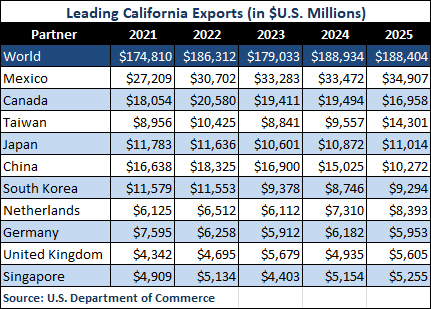
South Korea is California’s sixth largest export destination. California is also one of the top exporting states to Korea, making up roughly 13.5% of U.S. exports. In 2025, California exported more than $9.29 billion to South Korea. Top products from California to Korea included computers and electronic products ($2.07 billion), non-electrical machinery ($1.80 billon), processed foods ($1.20 billion), agricultural products ($678 million), and chemicals ($621 million).
California is the largest importing U.S. state for South Korean products with imports totaling $29.48 billion in 2025. Top imports were made up of computer and electronic products ($10.57 billion), transportation equipment ($6.37 billion), electrical equipment, appliance & components ($2.49 billion), chemicals ($2.11 billion), and petroleum & coal products ($2.02 billion).
FDI – South Korea
According to the most recent figures in 2025, U.S. foreign direct investment in Korea totaled roughly $37.4 billion and was concentrated largely in the manufacturing, banking, and wholesale trade sectors. Korean foreign direct investment (FDI) to the United States reached $95.2 billion and was the 12th largest source of FDI into the U.S.
Korean FDI supported 98,300 jobs, invested $2.7 billion into research and development, and invested another $12.4 billion to expanding U.S. exports. The top industry sectors for Korean FDI were auto components, industrial equipment, electronic components, software and IT services, food and beverages, and consumer electronics. Select USA
More than 1 million Korean Americans live in the United States, with over 30% living in California. Los Angeles County alone is home to over 154,000 residents of Korean origin, according to the Migration Policy Institute. There also is a large population of Korean students studying at higher education institutions across the U.S., with many Korean visitors entering the United States via the U.S. Visa Waiver Program.
In California, the eleventh largest source of FDI through foreign-owned enterprises (FOEs) is South Korea. In 2025, South Korean FOEs in California provided 21,160 jobs through 475 firms amounting to $2.25 billion in wages. The top jobs by sector are wholesale trade, manufacturing, transportation/warehousing/utilities, professional/business services, and education and health (World Trade Center Los Angeles FDI Report).
CalChamber Resources
- Korean American Chambers
- Korean Consulates in California
- International Trade FAQs
- GO-Biz Stats: South Korean FDI in CA
Business
- California Governor’s Office of Business and Economic Development (GO-Biz)
- U.S. Commercial Service Korea
- AmCham Korea
- Embassy of Korea
- City of Busan
- Invest in Gyeonggi
- Korea Chamber of Commerce and Industry
- Korea Economic Institute
- Korea International Trade Association
- Korea Trade (KOTRA)-Silicon Valley
- Korea Trade (KOTRA) North America
- U.S.-Korea Business Council
Cultural/Educational
- Sister State – Chungchongnam-do Province, South Korea
- Sister State – Jeju Province, South Korea
- Sister State – Republic of Korea
- International Universities/Programs
- Sister Cities International
CalChamber Receives Korean Presidential Citation
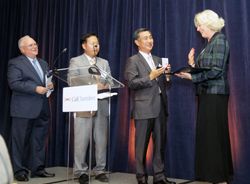
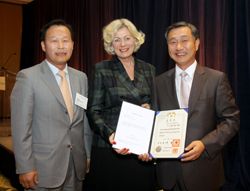
On Thursday, December 6, the California Chamber of Commerce received the prestigious Presidential Citation from the government of the Republic of Korea for promoting U.S.-Korea trade and commercial relations, and specifically for contributing to the passage of the U.S.-Korea Free Trade Agreement (FTA).
CalChamber, December 11, 2012
Pictured: Consul General Jeong Gwan Lee and Consul Kwang Ho Lee of the Korean Consulate General in San Francisco present the Korean Presidential Citation to Mrs. Susanne Stirling, Vice President International Affairs, with 2012 Chair Tim Dubois observing.