


Overview
California Chamber of Commerce Joins Gubernatorial Trade Mission to China
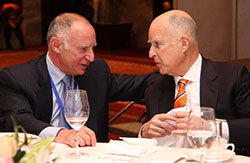
 The mission is to expand trade and investment between California and China by identifying opportunities that will be of mutual benefit. With more investment deals from China than any other state, California is positioned to capture China’s growing foreign investment.
The delegation will travel throughout China and open a California Trade and Investment Office in Shanghai. This will be California’s first official permanent presence in China in nearly a decade. As ambassadors for California, the delegation will take the next step to ensure the state’s leading role in attracting Chinese investment.
The Governor will be joined by a delegation organized by the Bay Area Council that includes approximately 75 business, economic development, investment and policy leaders from throughout California. Senior administration officials will also accompany the delegation.
Mission Accomplishments
During the Mission, the State of California became a party to five ambitious agreements with Chinese government officials to strengthen cooperation on trade and investment, economic growth, science and technology, climate change, environmental protection, public health, education, and tourism and culture. Please find the full texts of these agreements here:
- Memorandum of Understanding on Establishing “China Provinces and US California Joint Working Group on Trade and Investment Cooperation” (April 10, 2013)
- Agreement to Enhance Cooperation on Reducing Air Pollution between the Ministry of Environmental Protection of the People’s Republic of China and the State of California of the United States of America (April 10, 2013)
- Memorandum of Understanding On Friendly Cooperation between the State of California, United States of America and Jiangsu Province, People’s Republic of China (April 14, 2013)
- Memorandum of Understanding on the Friendly Exchanges and Cooperation Between the State of California of the United States of America and Guangdong Province of the People’s Republic of China (April 15, 2013)
- Memorandum of Understanding to Enhance Cooperation on Low Carbon Development Between the Government of Guangdong Province of the People’s Republic of China and the Government of the State of California of the United States of America (April 15, 2013)
Background / Media:
- Governor Brown to Lead Trade and Investment Mission to China Next Week
- California Opens New Trade and Investment Offices in China
To give California’s businesses a distinct advantage in China, Governor Edmund G. Brown Jr. recently announced plans to open new trade and investment offices in China.
From the Governor’s Office: February 2012
- Governor Brown to Open New Trade and Investment Office in China – 2-17-2012
- Governor Brown Outlines Plan for China-California Joint Task Force to Drive Investment and Collaboration – 2-17-2012
- UPDATED: Governor Brown to Welcome His Excellency Xi Jinping, Vice President of the People’s Republic of China, to California on Thursday 2-2012
For further information about the new Office, please see http://www.business.ca.gov/Programs/International-Affairs-and-Business-Development/International-Trade-Promotion/China-2013-Trade-Mission
Trade and Investment Overview
According to the U.S. State Department, China has been one of the world’s fastest growing economies over the last several years, and its efforts to reform and modernize have helped transform China into a large trading economy. China’s total trade is more than $3.6 trillion, making it the second largest trading nation and the country with the second largest economy in the world. This translates into enormous opportunities for U.S./California exporters.
U.S.-China trade has risen rapidly over the last several decades. Total trade between the two nations has increased from $4.8 billion in 1980 to slightly more than $536 billion in 2012. U.S. exports to China in 2012 were approximately $110.6 billion, a steady increase from previous years.
In 2012, China continued as California’s third largest export destination, with more than $14 billion in exports. Computer and electronic products accounted for approximately 28 percent of exports, totaling close to $3.9 billion. Waste and scrap material brought in $2.4 billion, or 17.4 percent, while both the machinery (except electrical) and the transportation equipment categories each accounted for approximately 10 percent of the total, with roughly $1.4 billion in exports each. U.S. Department of Commerce
Chinese Direct Investment in California
The Rhodium Group estimates that Chinese firms now employ 27,000 people in the U.S., up from fewer than 10,000 five years ago. Asia Society, October 2012
Recent Event
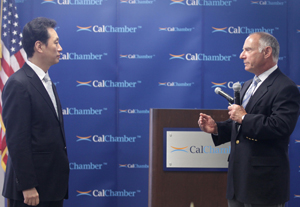
CalChamber President, Chinese Vice Minister: Foster Strong Ties Between California and China(July 24, 2012) Fostering business and cultural relationships between the California business community and China was the focus when Chinese Vice Minister of Commerce Wang Chao and his delegation gathered at the California Chamber of Commerce International Luncheon Forum yesterday.
Day 1
Monday, April 8, 2013 – Arrival in Beijing
 Blog By (Mrs.) Susanne Stirling
Vice President,
International Affairs
Allan Zaremberg, the president/CEO of the California Chamber of Commerce, and I arrived in Beijing this afternoon after a 13- hour flight on United Airlines (a long-standing CalChamber member). Before we landed, we managed to take in the view of Beijing from the air.
It is a vast change from my very first trip to China in 1988. Many more skyscrapers now dominate the city, there are more cars and fewer bicycles, and the air pollution is thick and heavy – especially depending on the winds from the Gobi Desert. Nestled between mountains to the north, west, and northeast, Beijing is a bustling capital city with both skyscrapers and ancient architecture. It has been a vital trade center for over a thousand years and will provide the perfect setting to strengthen the trade relationship between California and China.
After checking in and setting our clocks 15 hours ahead, the entire delegation met in the evening for welcome reception. We are staying at The Grand Hyatt Beijing, which is located in the heart of the city. Situated on Wangfujing, within walking distance of The Forbidden City and Tiananmen Square, the Grand Hyatt Beijing is part of Oriental Plaza – one of China’s largest commercial complexes.
Day 2
Tuesday, April 9, 2013 – Trade Briefing & More
The morning began with a session on building California-China trade and investment. In addition to the in-depth briefing, delegates participated in Q&A sessions with some of the foremost experts on the historical, economic, business and cultural ties between China and California. The group also heard from fellow delegates as to their successes and challenges in China.
Nancy McFadden, executive secretary in Governor Brown’s office, opened the briefing with words of welcome.
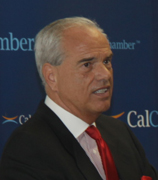
Mike Rossi
Mike Rossi, the Governor’s senior advisor, added his welcome to the Governor’s first trade delegation, commenting that this is a historic moment, and that it has been 10 years since the state has had an office abroad. He noted that studies show China will be investing to a new level in the United States, and California would like to be a part of that.
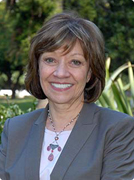
Karen Ross
Karen Ross, secretary of the California Department of Food and Agriculture, highlighted the state’s agricultural export strategy. Over the last year, agricultural exports from California to China have increased 53 percent to $1.1 billion. She forecasted positive growth for the upcoming few years.
China is currently California’s third largest global destination for agricultural products, following Canada and the European Union, with $1.7 billion in exports in 2011. This represents a 25 percent increase from 2010 and a 183 percent increase from 2007. Consistent with the state’s agricultural export profile, the top five products were almonds, pistachios, wine, walnuts, and cotton.
The California delegation includes members representing almonds, pistachios, raisins, strawberries, wine, and organic interests. The agricultural delegates will be meeting with high-level Chinese agricultural government officials, which is very important to gaining access to the Chinese market.
Lessons Being Learned
Top executives from three CalChamber member companies — Driscoll’s, SVB Global Private Equity Services and The Walt Disney Company — spoke about their experience doing business with China.
First we heard from Timothy Stratford, a partner of the law firm Covington & Burling, which has offices in Beijing and Shanghai. He highlighted the importance of knowing China’s legal system. Most of the growth in China has been in its infrastructure, but now there is a need to look beyond. Wages in China are increasing. The Chinese are seeking to build a more innovative economy and not just be the “factory of the world.” Now in its twelfth, “five-year plan,” China is eyeing new industries, especially in energy. It is important to know the approval procedure for foreign direct investment (FDI) into China, as not all FDI is permitted.
He pointed out that the 2013 American Chambers of Commerce Abroad (AmCham) Business Climate Survey is positive for companies that have “figured out” how to do business in China.
Meanwhile, China has had a major increase in outbound FDI, with a goal of increasing that figure by 17 percent each year, although that focus is a new experience for Chinese companies. The new leadership in China understands the environmental issues in China and the challenges faced by Chinese companies operating in a global society.
Sean Martin, chief financial officer of Driscoll’s, observed that there once were 25,000 cars made in China each year; now there are 14 million. He commented that if you look around in many Chinese cities, you will see at least 10 cranes, so there is much building all around. China’s joining the World Trade Organization (an action supported by the CalChamber) has made a major difference. Since then, the provincial governments have been more progressive in working internationally. Moreover, the new central administration in Beijing is looking to move China forward globally.
Andy Tsao, managing director of global private equity services for Silicon Valley Bank, said the commercial bank was founded in 1983 and located in Santa Clara with a focus on technology and agriculture. The bank is lending to small businesses in China also and has more than 300 clients in China. It is the first technology-focused bank operating in China.
Disney Shanghai Resort
Yvonne Pei, senior vice president of The Walt Disney Company, reported that the “Magic Kingdom is moving to the Middle Kingdom.” Now under construction is a Disney Park and Resort planned to open by the end of 2015 in Shanghai. The park will feature the largest Disney castle in the world, and is the company’s largest foreign investment overseas.
She said Disney has worked with the Chinese to allow more Disney movies into China, and is hoping to be able to open a Disney TV channel at some point. Right now the big focus is on the consumer products sold in China. Chinese parents spend a lot of money on their children’s education. Disney has created Disney English to help Chinese children learn English via listening to Disney stories. This is a bit different then the purely academic approach of learning English, and has been well-received by Chinese families. Disney is creating new characters, as western content is not shown on Chinese TV in the afternoon, so there will be use of both iconic Disney characters as well as new Chinese-specific Disney characters.
Matt Rodriguez, secretary of the California Environmental Protection Agency (Cal/EPA), said issues of importance to both the China and California economies include climate change, energy efficiency and automobile efficiency. Cal/EPA will be meeting with a number of Chinese government officials regarding these issues and discussing how a government can have strong environmental regulations while maintaining a strong economy, which is so important.
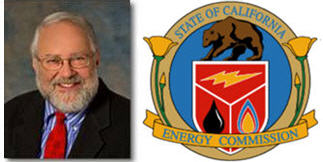
Robert Weisenmiller
Robert Weisenmiller, Ph.D., chair of the California Energy Commission, commented that California continues to be interested in reducing reliance on fossil fuels. A major issue and topic of discussion with the Chinese will be energy efficiency, including batteries and building standards.
Rosemary Gallent
Rosemary Gallent of the U.S. Embassy Beijing, said opportunities in China mirror the strengths of California. She noted that the embassy works in all areas of China and advised listeners to remember that the “second tier” cities have populations of 30 million, so companies should look to all markets. The U.S. Embassy Beijing has the largest U.S. commercial section abroad.
Conrad Wong, intellectual property rights (IPR) attache with the U.S. Embassy, reported that IPR enforcement is a big concern for companies in China. A company’s trademark is the most important, he said, so get it registered — the rule is ” first to file,” not “first to use.” He said companies need to work with central, provincial and municipal level governments in China on this issue and urged companies to talk and work directly on the IPR issue with their counterparts. The economy in China is moving to high-end products, he said.
Mike Heath, economic section unit chief at the U.S. Embassy, said the unit can help direct companies to a newly created data base that the AmCham in China is developing that lists investment projects and investment interest.

Caroline Beteta
Caroline Beteta spoke about California tourism. For the last 10 years, she has been the president and CEO of California Travel and Tourism Commission, which brings in an average of nearly $4 billion to the state’s economy. Visit California is a public-private partnership that has a presence in more than 20 countries.
The State Department reports that 1.18 million Chinese tourists visited the United States in FY 2012 (October 1, 2011 to September 30 2012), and China’s National Tourism Administration forecasts 2 million visitors to the U.S. by 2015. A million jobs in California are related to tourism, and California is the largest tourism state in the United States, she reported.
Caroline said Governor Edmund G. Brown Jr. will launch a new historic tourism campaign geared to the Chinese population this week. (Read the April 12 Visit California news release on the launching of the first consumer marketing campaign in China and appointment of a California tourism ambassador.) Although tourism is a service export listed differently than goods exports, tourism is equally valuable to the economy.
Caroline showed the California tourism video featuring actor Rob Lowe with the theme “Find Yourself Here.”
Tourism from China has grown significantly in the last two years due to several recent developments. In December 2007, China granted the United States “approved destination status,” allowing Chinese citizens to visit as tourists. The State Department also has speeded visa processing by adding consular personnel. Wait times for a visa have been reduced from 57 days in Beijing and 65 days in Shanghai in 2011 to as little as a week.

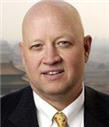
James McGregor
James McGregor, senior counselor with APCO Worldwide, was the final speaker. He has lived in China for more than 20 years and is the author of a number of books, including No Ancient Wisdom, No Followers: The Challenges of Chinese Authoritarian Capitalism and One Billion Customers: Lessons from the Front Lines of Doing Business in China. He is the former CEO of Dow Jones & Company in China and Wall Street Journal bureau chief in China and Taiwan.
He commented that growth in China has gone from bicycles to Bentleys in the major cities, but people from other cities have enjoyed growth now too, with international tourism packages.
James recommended China Inc.: How the Rise of the Next Superpower Challenges America and the World (Ted Fishman) as the key to understanding for investors. California companies are very concerned about risk, but the Chinese are interested in opportunities. The urbanization of China has been amazing, he said. For example, 50 million farmers have moved to cities. The emphasis in China is to build satellite cities about an hour outside of the major cities to house the population moving there. This population needs “housing registration” and they need to be moved in to the consumer class. Online shopping has taken off in just the last six months, he said, adding that it is open and more entertaining than television which is still state-run.
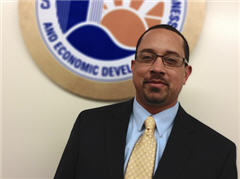
Kish Rajan
He also recommended reading The Party: The Secret World of China’s Communist Rulers (Richard McGregor).
Many thanks to Kish Rajan for facilitating the Q&A session. He serves as the director of the Governor’s Office of Business and Economic Development (GO-Biz).
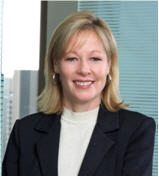
Janet Lamkin
Janet Lamkin, the California state president of Bank of America and chair of the Bay Area Council, as well as a CalChamber Board Member, wrapped up the event after thanking all of our informative speakers.
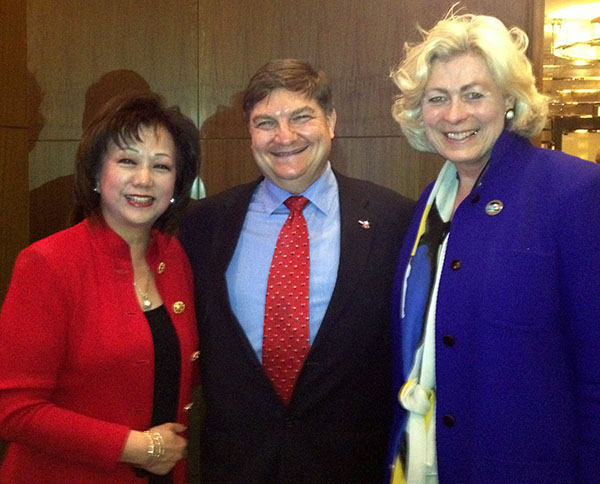
Margaret Wong, president and CEO of McWong International, Inc.,
Dale Wright of the U.S. Embassy, Commercial Section, and Susanne Stirling
Walking Tour
In the afternoon, we had the opportunity to explore the ancient Forbidden City and take a walking tour of Tiananmen Square. The Forbidden City dates back to the 15th Century and has been recognized by UNESCO as having the largest collection of ancient wooden structures in the world. We learned more about the architecture of the imperial palace. The buildings face to the south, because it was believed that the north was a harmful direction, as enemies of China often came down from the north. We also heard a few stories such as of the fire of the Hall of Venerating Heaven and the story of the Kangxi Emperor and Oboi.
Shandong Province
In the evening I met with Ma Xiao and Peter Lin from the Shandong Province. Mr. Xiao is the head of the party group of the China Council for the Promotion of Trade (CCPIT) in Shandong and the Shandong Chamber of Commerce. Mr. Lin is the director of the international relations department. Established in May 1952, the CCPIT comprises dedicated individuals, enterprises and organizations representing the economic and trade sectors in China. The CCPIT is a vital institution for promoting foreign trade in China. During the meeting, we discussed the Shandong Province’s plan for a business investment mission to California in the near future.
Shandong Province has a coastline of 1,864 miles (more than twice the length of the California coast!), and a population of nearly 100 million (almost three times more than California). Like California, Shandong is an agricultural region, producing chestnuts, peaches, walnuts, peanuts, soybeans, corn and wheat, among many other products. In addition, the province has more than 140 wineries, making wine production the second largest industry. Technology plays a major role in the province. Its capital, Jinan, has a High-Tech Industrial Development Zone, which has attracted major enterprises such as LG, Panasonic, Volvo, and Sanyo.
Shandong has a very diverse terrain, with mountains, rivers, lakes, hills, plains, deltas and basins, just like California. The climate is temperate, with warm and rainy summers and cold and dry winters.
Tourism is very prominent in the region. Many people come to Shandong every year to see its sights, including: Rongcheng, considered to be “the edge of the world,” Weifang, the “world capital of kites,” and its two World Heritage sites, Mount Taishan and the Temple, Mansion and Cemetery of Confucius.


Peter Lin (left) of CCPIT and Shandong Chamber, Susanne Stirling, and Ma Xiao of the CCPIT.
Dinner at China Club
The delegation concluded the day with dinner at the China Club. This Qing Dynasty restaurant is a former palace and a historical landmark that consists of four main interconnected pavilions and courtyards. It has been extensively renovated and restored to its royal glory. Governor Edmund G. Brown Jr. spoke to the delegation, saying he is looking forward to reporting on a number of successes during the week.
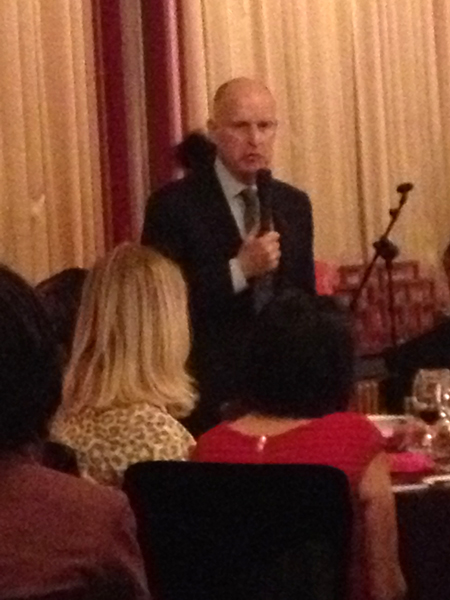
Governor Brown at the delegation dinner, which was hosted by United Airlines.
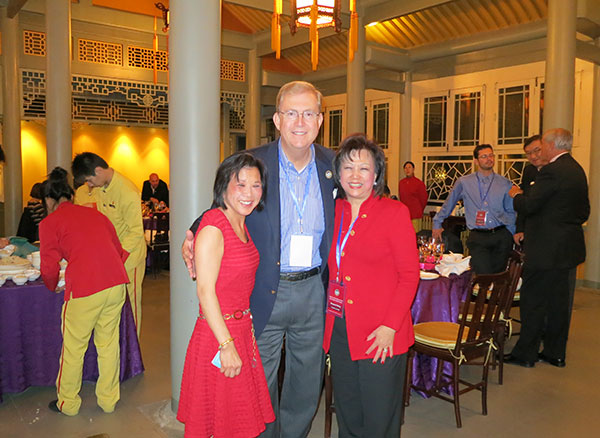
Melinda Yee of United Airlines (host of dinner), Bill Allen, president and CEO of the Los Angeles
Economic Development Corporation, Margaret Wong, president and CEO of McWong International, Inc.
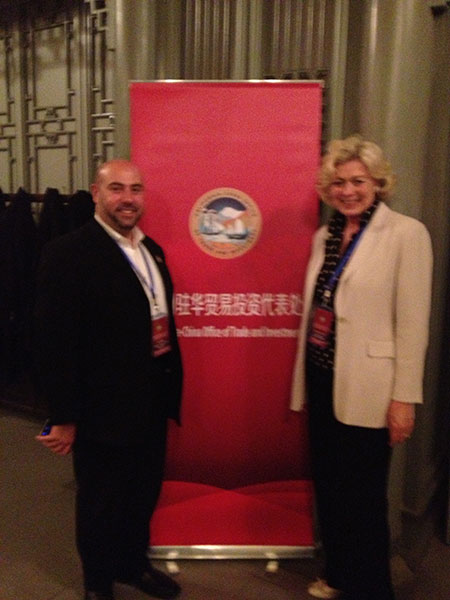
Paul Oliva, deputy director of international affairs and business development
for GO-Biz, and Susanne Stirling before the delegation dinner with the Governor.
Day 3
Wednesday, April 10, 2013: Governor; Investment Forum
The morning started with the signing of a memorandum of understanding (MOU) between Governor Brown and the Chinese Minister of Commerce Gao Hucheng and government officials from Jiangsu, Inner Mongolia, Shanghai, Shandong, Guangdong and Chongqing.
It was referenced by the Minister that the origins of this mission came from last year’s visit of the then- Vice President to Los Angeles to meet Governor Brown. Since then there has been an active working group of government officials from both China and California discussing key issues of importance. The Minister indicated that building new trade relations can be the cornerstone of a relationship — and that trade is not a zero-sum game, but a win for both sides. The Minister expressed that intellectual property protection was an issue for the Chinese government, just as export controls was an issue for the U.S.
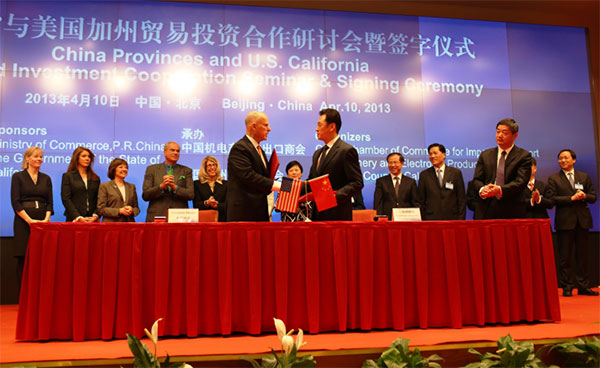
Governor Brown signs MOU with Vice Minister of Commerce Wang Chao – Photo: Nova Wang
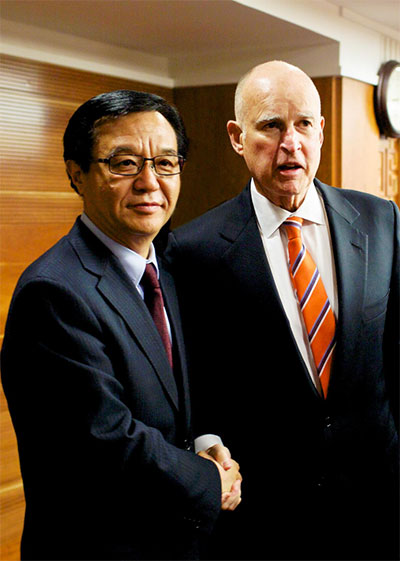
Governor Brown meets with China Minister of Commerce Gao Hucheng – Photo: Nova Wang
Governor Brown said this meeting is a solid move forward. He talked of the many changes in China since he last visited in 1986. The Governor explained the diversity in California and how the world is getting smaller. He said this meeting is the beginning that will lead to things which will impact the lives of millions of people.
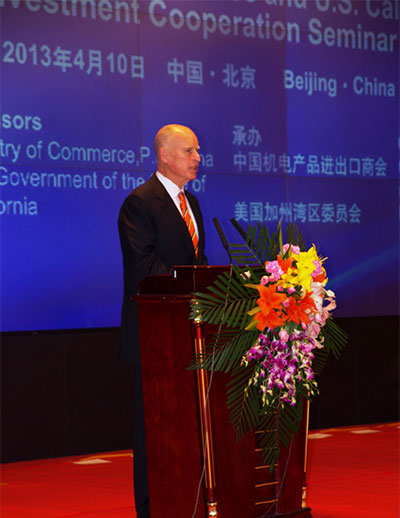
Governor Brown Delivers Remarks at the MOU Signing Ceremony – Photo: Nova Wang
Many Chinese government officials were on hand, together with more than 150 Chinese business representatives, so there was ample opportunity for the California delegates to make new connections. This was a true indication of the interest among the Chinese to move forward with increased investment in California.
Panels of both Chinese and California government officials went into further details about future cooperation.
This was followed by a press conference with media from China and the U.S. The delegation then proceeded to a luncheon hosted by the American Chamber of Commerce in Beijing.
The American Chamber of Commerce in the People’s Republic of China (AmCham China) is a non-profit organization that represents U.S. companies and individuals doing business in China. AmCham China’s membership comprises more than 3,500 individuals from more than 1,000 companies. It has more than 40 industry- and issue-specific forums and committees, offers unique services such as the Business Visa Program, holds a wide range of networking and informational events, and meets with U.S. and Chinese officials to discuss challenges and opportunities facing U.S. firms doing business in China.
The chamber, in addition to its headquarters in Beijing, has chapters in Central China (Wuhan), Northeast China (Dalian), and Tianjin. Its mission is to help American companies succeed in China through advocacy, information, networking and business support services.

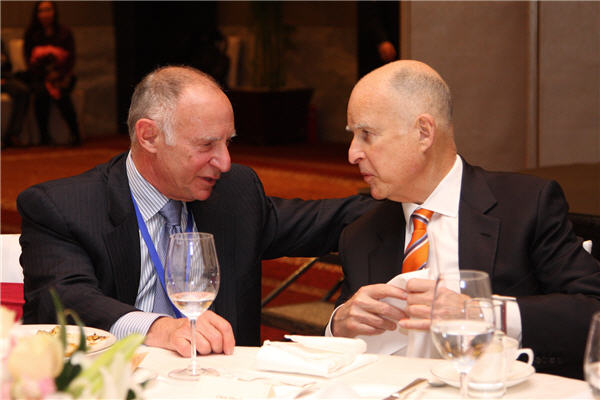
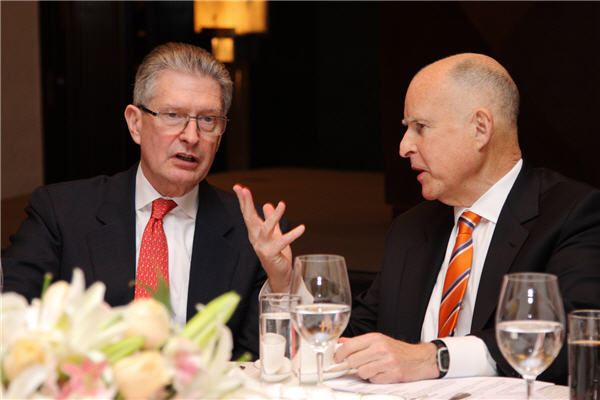
CalChamber President/CEO Allan Zaremberg and Governor Brown
Christian Murck, President of AmCham Beijing, and Governor Brown
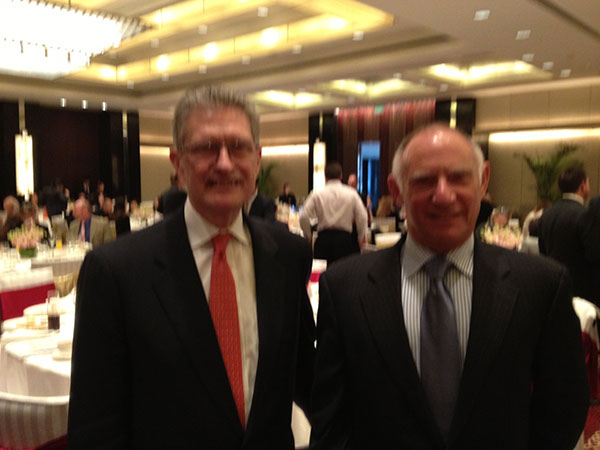
Christian Murck and Allan Zaremberg
Allan Zaremberg, President of the CalifornIa Chamber of Commerce, sat at the head table with the Governor and Christian Murck, President of AmCham Beijing. Murck was the former managing director of APCO in China. He has had a close working relationship with the CalChamber for many years now. Ten years ago, he attended the CalChamber International Breakfast and Board meeting and spoke on opportunities for California companies in China.
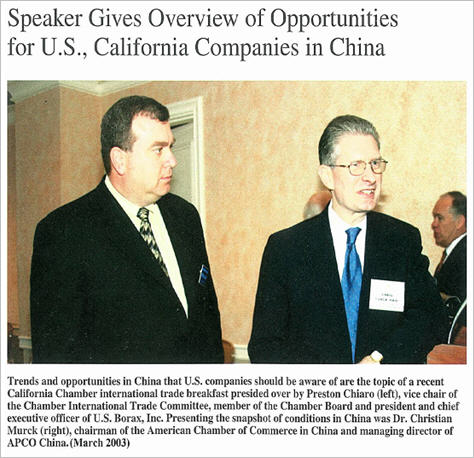
CalChamber Alert Newsletter – March 2003
The luncheon was hosted by HSBC, which opened a bank in 1865 in both Hong Kong and San Francisco.
Governor Brown and Chris Davies, deputy CEO of HSBC China, discussed a wide range of subjects important to the U.S.-China relationship in an interview setting.
In reference to the Governor’s 75th birthday on Sunday, the Governor explained how he had been the youngest U.S. Governor in the 20th century and the oldest U.S. Governor in the 21st century.

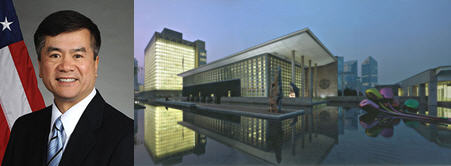
Ambassador Gary Locke U.S. Embassy in Beijing
In the evening, we departed for the U.S. Embassy in Beijing, built in 2008, for the California Investment Forum hosted by U.S. Ambassador Gary Locke. Ambassador Locke is the first Chinese American to serve as ambassador to China, as secretary of commerce and as Governor. He has had a good working relationship with the CalChamber. In 2009, Gary Locke presented the CalChamber with the President’s prestigious “Excellence for Export Service Award,” the nation’s highest award to honor U.S. exporters. He presented it during a ceremony at the National District Export Council Conference in Washington, D.C.
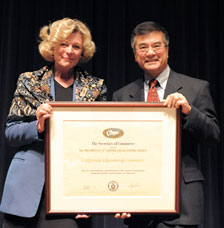
(2009) Gary Locke presenting the President’s “Excellence for Export Service Award” to Susanne Stirling on behalf of the CalChamber
The reception was attended by 300 Californian and Chinese business leaders and investors, organized by the U.S. Foreign Commercial Service, U.S. Ambassador Locke and the China Council for the Promotion of International Trade.
Ambassador Locke made insightful remarks about the future of the growing relationship between China and California. He noted that California plays a key role in China’s trading relationship with the United States. Vice Minister of Commerce Wang Chao spoke about the importance of this relationship. The Vice Minister visited California last July, when the California Chamber of Commerce hosted an International Luncheon Forum. Governor Brown followed by emphasizing that it is time to invest in California.
There was then an announcement of a major Chinese investment in an area south of Jack London Square in Oakland, together with the announcement of a program to expand the number of California community college students to learn Mandarin Chinese and study in China.
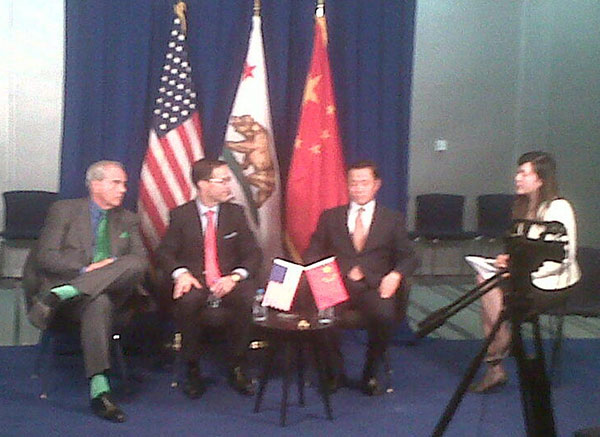
Senior Jobs Advisor Mike Rossi holds press conference with U.S. and Chinese investors – Photo: CAGoBiz (Twitter)
Following the reception, the delegation enjoyed dinner at the well-renowned Duck de Chine, which has been recognized as serving some of the city’s best roast duck.
Day 4
Thursday, April 11, 2013: China-California Dialogue
We checked out of the hotel very early this morning. After 45 minutes on our delegation buses, we reached the fourth highway ring around Beijing and the university sector of the city. Our destination was the prestigious Tsinghua University (THU). Each section of the city is allocated for a different purpose, i.e. services — insurance companies, banks, telecom — textiles, manufacturing, etc.
Very roughly there are 8,000 universities in the world. Nearly half are in the U.S. There are at least 2,000 in China — most of them newer — in addition to many new professional schools. The other approximately 2,000 universities are scattered around the world.
A central event of the California trade mission in Beijing, a summit, highlighted how California and China can work together to combat climate change and grow the economy.
Shared Path
This morning the delegates sat in on a China -California Dialogue entitled “Our Shared Path toward Energy Innovation and Low Carbon Development.”
Professor He JianKun, Director of the Institute of Low Carbon at the THU, welcomed all and introduced Governor Brown, who opened with a quote by Confucius and emphasized there is nothing more important than to learn. The Governor stressed that today climate change is the issue. He said that 97 percent of the scientists now recognize the importance of human beings on the climate. The Governor went on to indicate California’ s goal of having 1 million electric cars on the road by 2025. And that China could help by making better batteries!
The Governor said that dealing with the climate is mandatory, and each year we don’t solve the issue, the problem becomes more expensive and disruptive. “But,” he said, “I don’t just want to make you feel bad, so feel good! Because we are getting things done! We have one big world and not just one group can solve the problem. So human beings need to collaborate.”
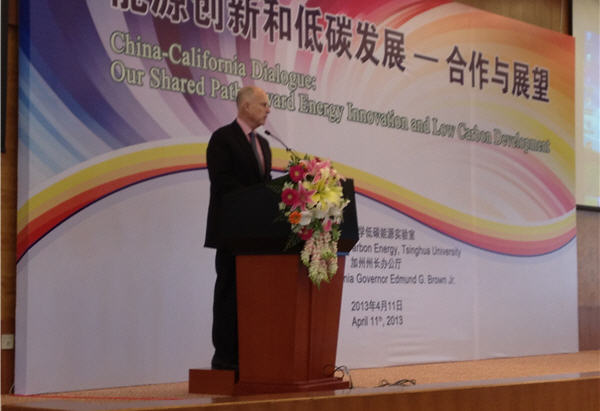
California Governor Brown speaks at Tsinghua University
Ms. Zhao Jiarong, who serves as Deputy Secretary General of the National Development and Reform Commission (NDRC), spoke next. In this role, she helps lead the Ministry’ s efforts on climate change. Ms. Jiarong previously served as Director General of the Resources Conservation and Environmental Protection Development of the NRDC. The NRDC is the “super ministry” responsible for planning China’s economic growth and limiting the country ‘s carbon emissions. The Deputy Secretary General stated that China takes this issue seriously and that it is part of the (12th) Five Year Plan. In 2009, China targeted a cut in CO2 emissions, with numerous provinces involved in pilot projects.
Professor Yao Qiang, Executive Director of the Low Carbon Energy Laboratory at THU, gave a presentation on China’s climate and energy efforts. He also serves as the Executive Director of the Low Carbon Energy University Alliance among Tsinghua-Cambridge- MIT.
The event was held at the impressive Tsinghua University, which has been widely recognized as one of the top two universities in mainland China. As the recipient of the 2011 National Science and Technology Award, the university provided an excellent venue to address these issues.Tsinghua University Grand Auditorium
Following the presentations, there was a panel/conversation on energy innovation and clean technology development. The moderator was Li Junfeng, Director General of the Chinese National Center of Climate Change Strategy and International Cooperation (NCCS) and President of Chinese Renewable Energy Industries Association (CREIA).
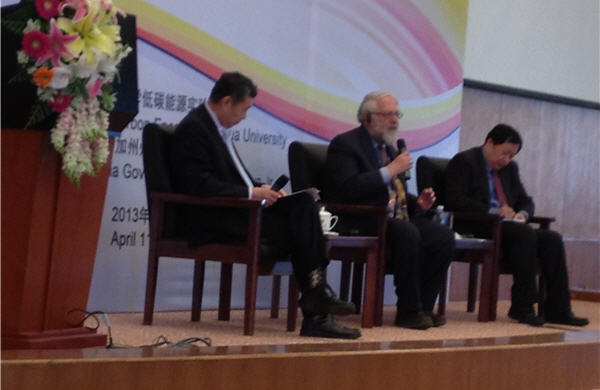
From left: moderator Li Junfeng and speakers Bob Weisenmiller and Wang Zhongying.
Bob Weisenmiller, Chairman of the California Energy Commission, stated that energy efficiency is the key. Building standards are important and we need to build correctly from the start. Further, 40 percent of energy in California is in transportation, so electric vehicles are important. The Chairman concluded by saying that we “have to put a price on carbon; we need a post-carbon economy.”
Wang Zhongying, Deputy Director General of the Energy Research Institute (ERI), National Development and Reform Commission, who had just returned from the U.S., spoke in a personal capacity, saying that China is lagging behind in renewable energy, but is making progress in wind and solar power installation. He noted the recent major smog in Beijing and other cities with power plants. Most energy in China is currently based on coal generation.
Governor and China Premier
Later, Governor Brown met with China’s Premier, Li Keqiang.
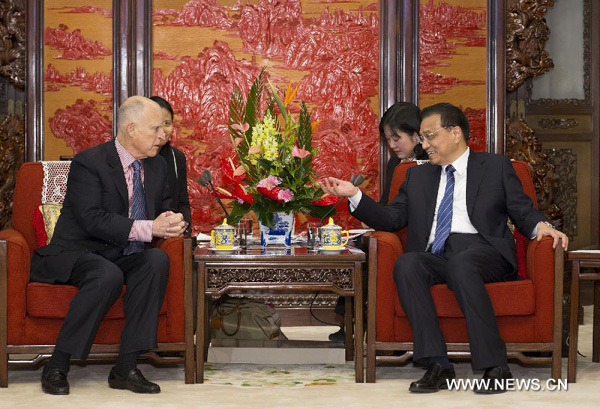
Chinese Premier Li Keqiang (R) meets with visiting California Governor Jerry Brown in Beijing
High-Speed Rail
The delegation then boarded the high-speed rail to travel from Beijing to Shanghai. It is the world’s longest high-speed rail, with an average speed of 186 miles per hour! The journey took approximately 5 hours to travel almost 780 miles, which is more than the length of California.

High Speed Rail departing Beijing for Shanghai. There are 16 cars. Travel time approximately five hours.
A news article was published today in the China Daily Newspaper which describes a new route on the high-speed rail system. The article can be found here.
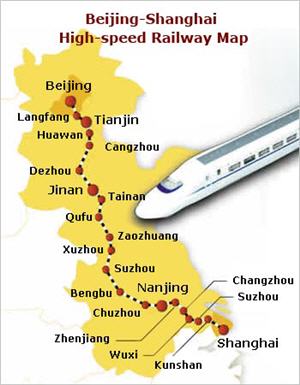
We arrived at Shanghai Hongqiao Railway Station. The Chinese government has invested expansively in its high-speed rail network. China now has the world’s longest high-speed rail network, with routes stretching more than 5,800 miles across the country. This past December, China opened the world’s longest single high-speed rail line, which runs from Beijing to Guangzhou at 186 miles per hour – the equivalent of traveling from New York to Key West in eight hours. Approximately 1.33 million people rode China high-speed rail per day in 2012. High-speed rail service was introduced in the country in April 2007.
Dinner in Shanghai
Upon arrival, we enjoyed a dinner at ZEN restaurant. The restaurant is located in an area recreated and born out of the sprawls of Shikumen housing, the architectural symbol of Shanghai in the 20th century. Shanghai Xintiandi is a window to the past and the future, to China and the world. Shanghai Xintiandi was created by converting residential blocks into a dining, retail and entertainment center flowing with restaurants, boutiques, cafes and bars. The Shikumen buildings within Shanghai Xintiandi retain the antique walls, tiles and exterior of the Shikumen housing of old Shanghai.
The delegation is staying at the Hyatt on the Bund, which features spectacular views of Shanghai’s famous Bund and the skyscrapers of Pudong over the Huangpu River.
Shanghai, the “City Above the Sea,” is a global powerhouse. The city concurrently is known as a major financial center, fashion metropolis, architectural wonder, and center of international trade. With more than 23 million residents, Shanghai is the largest city by population in the world, and has been considered the showpiece for China’s modern mainland economy. But Shanghai had more humble beginnings: the city lies on the Yangtze River delta, and until 1842 was a small fishing village.
Day 5
Friday, April 12, 2013: California-China Office of Trade and Investment (Shanghai)
This was a very important day for both California and China, marking the opening of the California-China Office of Trade and Investment and official unveiling ceremony!
The event marks California’s first permanent trade presence in China since 2003. This new office will bring together two of the largest economies in the world. It will strengthen two-way trade and will promote reciprocal investment between California and China.
Opening of California-China Office
The morning began with a formal office opening ceremony. Janet Lamkin, chair of the Bay Area Council (also California state president of Bank of America a CalChamber Board member), welcomed and introduced dignitaries, including Ms. Wenjun Hu, deputy director of the Shanghai Municipal Commission of Commerce and Mr. Chen Yin, Shanghai Yangpu Party secretary. Both California U.S. Senator Dianne Feinstein and U.S. Ambassador Gary Locke sent video welcomes. U.S. Consul General Robert Griffiths, posted in Shanghai, added his welcome. Governor Brown spoke briefly and said how happy he was to see California and China linked.
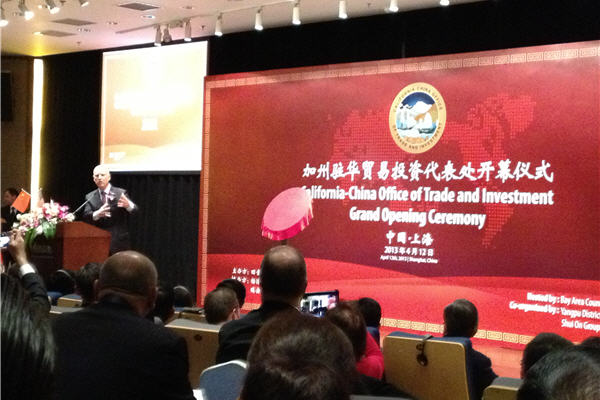
Governor Brown speaks at the opening of the California office in Shanghai’s Yangpu District.
An unveiling of the new seal for the California-China Office followed.
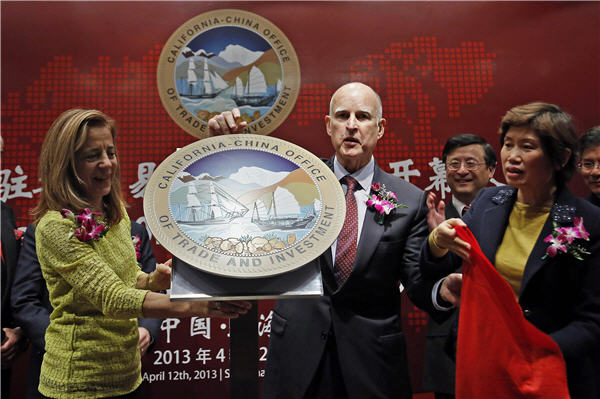
Governor Brown unveils the seal for the California-China Office. At left is First Lady Anne Gust Brown. At right is Wenjun Hu,
deputy director of the Shanghai Municipal Commission of Commerce. (Associated Press photo)
There was a signing of initial deals, including a $20 million contract involving Sacramento-based McWong International (a CalChamber member) and Emeryville-based New Logic Research with Inner Mongolia-based ChinaCoal Mengda New Energy Chemical Company and China National Coal Group for a zero-liquid-waste discharge project. McWong International also is in the final stages of forming a strategic partnership to clean up industrial water in China.
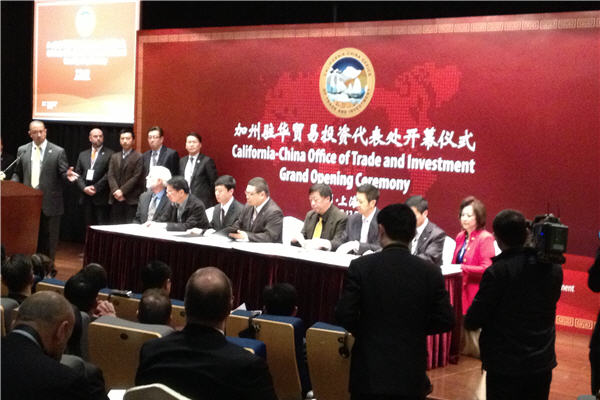
Signing ceremony of initial deals following California office opening, including Margaret Wong (at right), McWong International.
California-China Office of Trade and Investment Address:

Investment Reception
The ceremony was followed by a reception allowing for California delegates to meet with Chinese business and government leaders – and discuss possible investment opportunities.
With government influence, Chinese foreign direct investment into the United States has grown dramatically, from less than $1 billion in 2008 to an estimated $6.5 billion in 2012. The Rhodium Group projects that China’s cumulative outbound foreign direct investment will grow to between $1 trillion and $2 trillion by 2020; of that, California has the potential to attract between $10 billion and $60 billion of Chinese investment.
Many thanks to Shanghai’s Yangpu District for organizing a banquet lunch to celebrate the unveiling of the California-China Office of Trade. Yangpu is one of the 19 districts in Shanghai and home to 1.3 million inhabitants. As the largest downtown district, Yangpu has the largest concentration of universities and research centers in China, backing by the central government as an official innovation zone, sites ripe for new development and redevelopment, and quick access by road and subway to the rest of Shanghai. Yangpu already has become home to a growing cluster of exciting companies, including many from California.
To wrap up our last full day in China, the delegation attended a press conference followed by a California Lifestyle Reception and Wine Makers’ Dinner – organized by the Visit California team.
The Governor and Visit California launched a consumer marketing campaign in China and announced the appointment of model-actress Miss Gao Yuanyuan as California tourism ambassador. See news release.
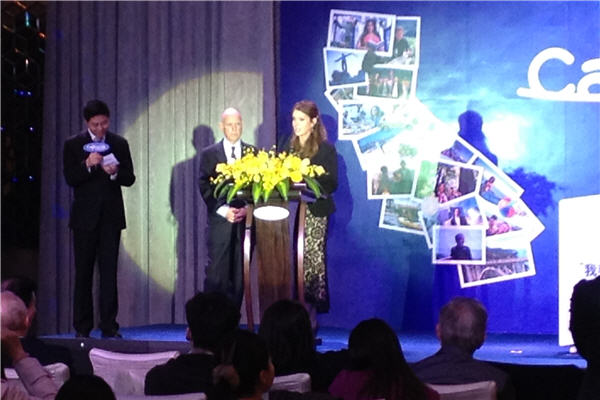
Governor Brown and Caroline Beteta of Visit California announce new consumer marketing campaign in China and tourism ambassador.
Spotlight on California Agriculture
The reception following featured California agriculture products and displays along with a cooking demonstration by chef Brad Turley of the GOGA Restaurant in Shanghai, which serves California-Asian cuisine. He is a native of San Francisco and named his establishment after the Golden Gate Bridge.
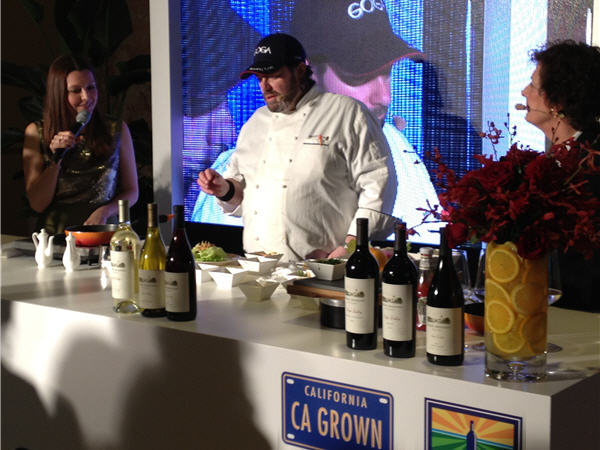
GOGA restaurant chef Brad Turley demonstrates cooking with California products.
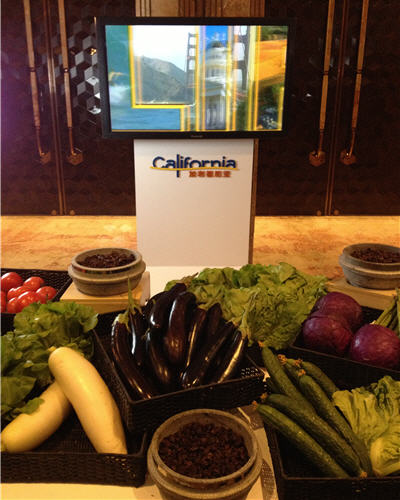
A sampling of California agricultural products.p
Guests at these events included tour operators, agricultural buyers and the media.
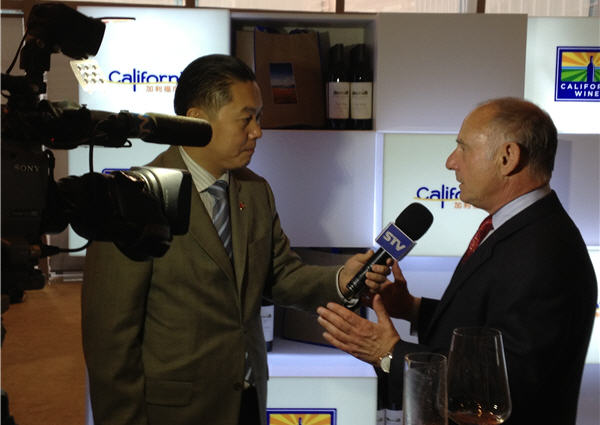
CalChamber President and CEO Allan Zaremberg talks to Shanghai TV about the trade mission.
Dinner was served with wine provided via the California Wine Institute.
As Chinese tastes change and consumption grows, wine offers a particular business opportunity. According to the Wine Institute, California accounts for 90 percent of global wine sales by the United States. Of this, China is a small but growing market. In 2011, U.S. wine exports to China (primarily from California) totaled $62 million, 42 percent higher than in 2010 ($44 million). This makes China the fifth largest global destination for U.S. wine, after the European Union ($478 million), Canada ($379 million), Hong Kong ($163 million) and Japan ($105 million). As these figures show, sales to China are only a fraction of those to other major markets, but the growth rate is promising. The major competitors are Australia, Europe and domestic Chinese producers. It should be noted that Hong Kong recently became a free trade zone for wine, generating a dynamic regional wine market.
What a perfect way to end a busy and productive week in China! This trip has effectively strengthened ties between China and California, which I am confident will continue to thrive.
The Bay Area Council has done an impressive job of organizing the mission together with the California Governor’s Office and GO-Biz. The delegation is very thankful to our many gracious Chinese hosts for organizing events throughout the week. The trade mission concludes with one more day in Guangzhou. Thanks for following the trip blog!
Acknowledgments
Having been involved in organizing gubernatorial trade missions going back to Governor George Deukmejian, with the establishment of the first California State Trade and Investment Offices around the world, I know the amount of “behind the scenes” work that goes into a successful mission.
This was a large mission with many components, including agriculture, energy and tourism. Thanks and congratulations to all involved including: the Bay Area Council – John Grubb, Wei Bing, Del Christensen, Genevieve Herreria, Elizabeth Cheng; the Governor’s Office of Business and Economic Development (GO-Biz) – Kish Rajan, Alexis Podesta, Paul Oliva, Brook Taylor and Abby Browning; the California Department of Food and Agriculture – Josh Eddy; and all the talented individuals at Visit California. And a special thanks to the U.S. Embassy, which is crucial to the success of any mission. Individuals such as Dale Wright (originally from Sacramento) in the Commercial Section are invaluable contacts.
A bit of history: The California Chamber of Commerce hosted a reception in the mid-1980s for 500 people celebrating the first California Trade and Investment Office opening in Tokyo. Under Governor Deukmejian and with the assistance of Jim Robinson, we continued this model and more offices followed in London, Frankfurt, Mexico City, Hong Kong and Taipei.
Next, Governor Pete Wilson and Business, Transportation and Housing Agency Secretary Julie Meier Wright opened offices and established representations in Israel, Johannesburg, Seoul, Shanghai, and Singapore.
Following the unfortunate closing of the California Department of Commerce and the related state foreign trade and investment offices due to budget cuts, Governor Arnold Schwarzenegger continued marketing California with the assistance of Will Fox and Garrett Ashley with missions to Asia, Europe, Canada and Mexico.
Now under Governor Brown and with the assistance of GO-Biz, the state once again is on a path of recognition regarding the importance of trade and investment to California’s economy, and commercial diplomacy has become an accepted methodology.
In 2012, California exported $161.7.4 billion to 225 foreign economies. China continues to be California’s third largest export destination, with over $14 billion in exports.
And last, but not least, thanks to my colleagues at the California Chamber of Commerce who have assisted with daily production of this blog, including my assistant, Mary Douglass; Steve Dormann, Web managing editor; Sara Espinosa, publications editor; Neil Ishikawa, art director; and Ann Amioka, vice president of communications.
News
Jerry Brown ends China trip at ease with diplomacy, his role abroad
Sacramento Bee, April 17, 2013
Governor Brown Meets with Shenzhen Party Secretary, Tours Electric Vehicle Manufacturer on Last Leg of China Trade and Investment Mission
Governor’s Office, April 16, 2013
Calif. needs cleaner China, says Brown
News: ABC 10, April 16, 2013
Brown administration signs carbon-reduction agreement in China
Sacramento Bee, April 15, 2013
Governor Brown Commits to Expanding Cooperation on Trade, Investment and Climate Change with China’s Largest Provincial Economy
Governor’s Office, April 15, 2013
China cast in role of tourism hero
China Daily, April 15, 2013
California, Jiangsu strengthen ties
China Daily, April 15, 2013
California opens Shanghai trade office
China Daily, April 15, 2013
California pledges environmental cooperation with China province
LA Times, April 15, 2013
Gov. Jerry Brown says goodbye to China delegation
LA Times, April 15, 2013
Jerry Brown toasts delegates on last night in China
Sacramento Bee Blog, April 15, 2013
California Strengthens Partnership with Sister-State in China
Governor’s Office, April 14, 2013
Governor toasts Shanghai with Yao Ming
ABC 10, April 13, 2013
Jerry Brown gets assist from Yao Ming during Shanghai river cruise
LA Times, April 13, 2013
VIDEO: Jerry Brown meets Yao Ming, cruises Huangpu River
Sacramento Bee, April 13, 2013
Sacramento firm McWong International lands China deal
Sacramento Business Journal, April 12, 2013
Photo Release: Governor Brown Meets with Shanghai’s Party Secretary
Governor’s Office, April 12, 2013
Shanghai – an Excellent Market for California Agriculture
(Blog) Karen Ross, California Department of Food and Agriculture, April 12, 2013
Visit California Launches 1st Consumer Marketing Campaign in China & Appoints Miss Gao Yuanyan as California Tourism Ambassador
Visit California, April 12, 2013
Photo Release: Governor Brown’s Trade and Investment Mission in Shanghai
Governor’s Office, April 12, 2013
Bay Area Council Joins Gov. Brown to Open First CA-China Trade Office in 10 Years
Bay Area Council, April 12, 2013
Senator Feinstein Welcomes New California-China Trade and Investment Office
(Video), Bay Area Council, April 12, 2013
California Opens Trade and Investment Office in China
Bay Area Council, April 12, 2013
Governor Jerry Brown praises Chinese for bullet train
Mercury News, April 12, 2013
Chinese investment is finally heading where it’s really needed: Oakland
Quartz, April 11, 2013
Jerry Brown makes cosmic case for carbon reduction
LA Times, April 11, 2013
Photo Release: Governor Brown Meets with China’s Premier
Governor’s office, April 11, 2013
California Opens Trade and Investment Office in China
Governor’s Office, April 11, 2013
California Gov. Jerry Brown rides Chinese bullet train [Video]
Los Angeles Times, April 11, 2013
Chinese Premier meets U.S. state governor
Xinhua English.news.cn-China, April 11, 2013
Gov. Jerry Brown in China
The Sacramento Bee, April 11, 2013
California and China: Growing Together
(Blog) Karen Ross from the California Department of Food and Agriculture, April 11, 2013
Bay Area Council Applauds $1.5 Billion China Investment Deal Announced by Gov. Brown in Beijing
Bay Area Council, April 10, 2013
In China, business cards are serious business
Los Angeles Times, April 10, 2013
Governor Brown Joins Ambassador Locke at U.S. Embassy Reception, Announces $1.5 Billion China-California Investment Deal
Governor’s Office, April 10, 2013
Governor Brown Signs First-of-its-Kind Agreement with China’s Minister of Environmental Protection to Help Improve Air Quality
Governor’s Office, April 10, 2013
Governor Brown and Ministry of Commerce Partner to Boost Bilateral Trade and Investment
Governor’s Office, April 9, 2013
As Brown visits China, California-Quebec carbon-trade deal advances
Los Angeles Times, April 9, 2013
Brown Goes To China
MyMotherLoad.com, April 9, 2013
California Wines Get A Boost From Governor Brown’s China Trade Mission
Market Watch, April 9, 2013
China Welcomes California!
(Blog) Karen Ross, CA Department of Food and Agriculture, April 9, 2013
Trade, environment to dominate Jerry Brown’s first day in China
Los Angeles Times, April 9, 2013
Jerry Brown arrives in China, looking for ‘greenbacks’
The Sacramento Bee, April 9, 2013
Brown kicks off China tour
ABC News, April 9, 2013
California trade delegation arrives in China
Los Angeles Times, April 9, 2013
California trade mission to China off and running
(Video) ABC News, April 8, 2013
California says to China “Here we come”
California Economic Summit, April 8, 2013
UPDATED: Governor Brown to Lead Trade and Investment Mission to China This Week
Governor’s Office, April 8, 2013
Business leaders joining Jerry Brown in China hope he can open doors
Los Angeles Times, April 8, 2013
Gov. Brown will mean business on his weeklong trip to China
Los Angeles Times, April 7, 2013
Jerry Brown heads to China to get ‘billions’ in investment
The Sacramento Bee, April 7, 2013
Viewpoints: On the eve of Brown’s trip to China: Revaluing California’s export trade
The Sacramento Bee, April 6, 2013
Calif. governor looks to China for investments
The Sacramento Bee, April 6, 2013
California Governor Jerry Brown looks to sell China on his state
Reuters, April 6, 2013
Brown heads to China for trade talks
ABC News, April 6, 2013
CalChamber to Join Governor on Trade Mission to China
CalChamber, April 5, 2013
Governor Brown to Lead Trade and Investment Mission to China Next Week
GO-Biz, April 4, 2013
Gov. Jerry Brown details his upcoming China trip
Los Angeles Times, April 3, 2013