Trading Partner Portal: Canada
Canadian American Business Council (CABC) Launches New Economic Report on the Impacts of
US-Canada Tariff Escalation and USMCA
August 10, 2026
Letter from Canada-U.S. Trade Minister Dominic LeBlanc on USMCA Renewal
Government of Canada, June 1, 2026
CalChamber Submits Comments on Review
of US-Mexico-Canada Agreement
CalChamber, November 4, 2025
Governor Newsom and Visit California launch international tourism campaign welcoming Canadians to experience the warmth and love of the Golden State
Governor of California, April 14, 2025
Guest Commentary: The True Cost of U.S. Tariffs on Canada
Rana Sarkar, Consul General of Canada in Northern California, February 25, 2025
Trump Tariffs: Some Put on Hold, Others Take Effect
CalChamber, February 4, 2025
List of products from the United States subject to 25 per cent tariffs effective February 4, 2025
Department of Finance, Canada
Trump Tariff Plans Cause Concern, Much Speculation
CalChamber, January 31, 2025
Guest Commentary: Securing
North American Prosperity
CalChamber, April 16, 2024
Partners in Prosperity: Exploring the Significance of Canada – U.S. Trade
Canadian Chamber of Commerce, October 2024
Trade Overview

Canada is the second largest country in the world in land mass after Russia, accounting for around two-fifths of North America. As well as the mainland, it holds thousands of nearby islands such as the Arctic Archipelago and Newfoundland. Canada has a southern border with the United States, a western border with Alaska, and has Greenland in its eastern region. It holds coasts with the Pacific, Arctic, and Atlantic Oceans, and contains mountainous regions, plains, basins, and forests. Britannica
While large in land mass, it is also one of the most sparsely populated countries in the world. Canada is known for its diverse population, with total population as of 2025 being 41.65 million people, with, GDP coming in at $2.32 trillion. It has been rated the tenth largest economy in the world and also sees some of the highest incomes per capita. Key industries such as services, natural gas, and manufacturing continue to be a large contributor to the economy, with its service industry being the most dominant. U.S. Department of Commerce
Canada is a constitutional monarchy with a highly complex market economy, ranking 30 in complexity from the Economic Complexity Index, and ranked nineteenth in most talent competitive countries for its ability to nurture and find talent in its workforce (IMD World Competitiveness Center). It has growing sectors in technology, aerospace, and renewable energy, as well as having the second-largest automotive industry in North America, which is closely integrated under the USMCA with the U.S. and Mexico. Its technological sectors are notable as they are highly trade dependent and expected to grow through 2026. The of Observatory of Economic Complexity, U.S. Department of Commerce
U.S. – Canada Trade
The United States and Canada enjoy one of the largest bilateral trade and investment relationship in the world, with Canada being second in U.S. goods export markets and in two-way trade. In 2025, two-way trade in goods between Canada and the United States was $712.76 billion. When subtracting goods exports from goods imports, the U.S. currently holds a goods trade deficit of -$64.19 billion with Canada according to data from the U.S. Department of Commerce.
Exports to Canada totaled $348.5 billion, with top exports being transportation equipment ($69.76 billion), chemicals ($37.07 billion), non-electrical machinery ($36.44 billion), computer and electronic products ($25.58 billion), and other special classification provisions ($25.17 billion).
Imports in this same year totaled $412.7 billion, with Canada being ranked 3rd in U.S. import markets. The top 5 imports from Canada were oil and gas ($106.25 billion), transportation equipment ($67.59 billion), primary metals manufactures ($32.17 billion), processed foods ($30.19 billion), and chemicals ($30.02 billon). Canada is increasingly receptive to U.S. goods and services, as both countries share close geographical ties and similar cultures. Canada is also the largest and most secure supplier of energy, such as oil, natural gas, electricity and nuclear fuel. U.S. Department of Commerce
Total services trade equaled $150.24 billion with exports equaling $89.55 billion and imports $60.69 billion. Top services trade export categories were other business services, manufacturing, travel, financial services, and telecommunications, computer, & information services.
Top import categories from Canada to the U.S. were other business services, telecommunications, computers & information services, travel, transport, and financial services.
California- Canada Trade
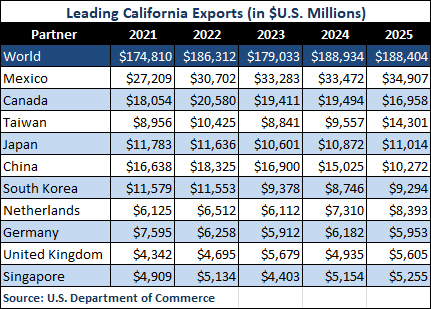
Canada has remained California’s second largest export market since 2006, with a total value of around $16.96 billion in 2025. Top exports being computer and electronic products ($3.76 billion), agricultural products ($2.54 billion), transportation equipment ($1.75 billion), processed foods ($1.69 billion), and chemicals ($1.13 billion).
California imported a total of $15.43 billion from Canada in 2025. Top five imports were processed foods ($3.70 billion), oil and gas ($2.56 billion), chemicals ($929 million), computer & electronic products ($878 million), and non-electrical machinery ($816 million). California currently holds a goods trade surplus with Canada of roughly $1.53 billion.
According to the Canadian government, two-way trade between California and Canada equals $53 billion annually; with 1,928 Canadian owned firms, employing 90,250 workers in California. (Connect2Canada)
According to Visit California, nearly 1.7 million people visited California from Canada in 2024, with spending at nearly $3.7 billion.
FDI – Canada
According to the most recent figures, the U.S. invested approximately $488.1 billion into Canada and foreign direct investment from Canada into the U.S. was just over $747.3 billion in 2025 (Bureau of Economic Analysis). Canada continues to be the second largest source of FDI in the U.S., with FDI from Canada directly supporting 887,900 jobs in the U.S. Canada invested $1.7 billion in research and development and contributed a value of $16.8 billion towards expanding U.S. exports. Canadian FDI is continuing to grow, as it is ranked the 11th fastest-growign source of FDI in the United States. The top U.S. industry sectors that Canada FDI goes to are software and IT services, business services, real estate, financial services, industrial equipment, and renewable energy (SelectUSA).
In 2025, Canada was the third largest source of FDI through foreign-owned enterprises (FOEs) in California. Canadian FOEs provided over 101,536 jobs through 2,159 firms amounting to $10.62 billion in wages. The top jobs by sector are professional and business services, retail trade, financial activities, manufacturing, and wholesale trade (World Trade Center Los Angeles FDI Report).
More Articles:
A New Horizon of Opportunity: Canada in the Indo-Pacific
Commonwealth Club, March 30, 2023
Interview Series Featuring California’s Key Trading Partners – Featuring Rana Sarkar, Consul General of Canada in San Francisco:
Friendship with California More Important than Ever in Global Pandemic Fallout
CalChamber, August 7, 2020
California-Canadian Trade and Business Information
- California and Canada Fact Sheet – Connect2Canada
- U.S. Census Bureau Trade in Goods – Canada
WTO Trade Statistics
CalChamber Resources
- Canadian Consulates in California
- Canada-California Trade Statistics
- International Trade FAQs
- GO-Biz Stats: Canadian FDI in CA
- USMCA Tracker Data Tool from the Brookings Institute
Business
- California Governor’s Office of Business and Economic Development (GO-Biz)
- U.S. Commercial Service in Canada
- AmCham Canada
- Canadian Department of Foreign Affairs, Trade and Development
- Connect2Canada
- Invest in Canada
- Canadian Association of Importers and Exporters
- C-100
- British Columbia – Trade and Invest
- Invest in Ontario
- Quebec Government Office
- Surrey Board of Trade (Chamber of Commerce)
- Canada and the US – Business
- Canada-U.S. Regulatory Cooperation Council (RCC)