
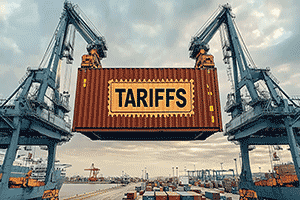
 California Chamber of Commerce members report new federal tariffs have had a variety of impacts on their companies and believe more challenges are on the horizon, including a growing likelihood that their prices will go up.
Those sentiments were shared in a brief online survey of CalChamber members representing a variety of economic sectors. The organization has been a steady voice through the years against protectionist measures which create uncertainty and hinder the competitiveness of California business.
In anticipation of potential supply chain difficulties, respondents cite a number of strategies. These include looking into different suppliers for parts within the United States, sourcing materials from countries that are less affected by the higher tariffs, sharing the cost with customers, and buying in larger quantities when prices are lower or tariffs are suspended.
Other companies are building additional costs into their project bids, cutting expenses and placing a freeze on hiring due to ongoing uncertainty over tariff policies.
“Reducing inventory, remaining aware, vigilant,” commented one business owner.
“Raising prices cautiously. . . have been and already have a drop in sales,” reported another respondent.
Timing of purchases was critical. As one respondent said, “We had to purchase an air conditioning unit and our provider had stockpiled a few before the tariffs hit. We would have faced double the cost.”
This Year
Two-thirds of those responding (67%) say they will end 2025 with the tariffs having had a negative effect on their business.
Asked in what ways they are being affected negatively by tariffs, just less than half (48.5%) cited profit margins and revenue (39%). About 45% said they were absorbing the cost internally.
“The company is currently absorbing about half of the tariff costs and passing the other half to customers,” said one respondent. “This policy will not last much longer as sales are dropping and costs are increasing.”
Other impacts identified in the multiple-choice question were stock/inventory planning (38.6%), finding new foreign suppliers (15%), scaling down (10.5%), ability to hire (10%), relocating production or services (6.67%), and investments (6.2%).
Manufacturing made up the single largest proportion of respondents (20%), followed by health care (9%), retailers (8%), nonprofits (8%), wholesalers (7.6%) and tourism/hospitality (7%). Other industry categories represented included construction (6%), education (5%), and legal services (4.7%).
Passing Along Increases
Asked about passing through tariff cost increases to customers in the next three months, respondents were almost evenly split. But a larger number believed prices would rise in the next six months, though a roughly equal number of businesses were unsure.
Asked how the prices their company charges have changed compared to six months ago, 51.9% reported increased prices, 45.7% no change and 2.38% a decrease in prices.
More than 8 in 10 survey respondents reported the prices their company pays for goods and services have increased compared to six months ago, with 18% saying there had been no change.
Next Year
 Looking ahead to 2026, more than 62% of respondents said they expect current tariffs will have a negative impact on their business next year, with 24% being unsure, 11% expecting no impact and just 2.38% predicting a positive impact.
While business leaders believe they will need to pass along tariff costs to their customers, they’re unsure of the exact amount. Just less than 22% said they would pass along some cost increases.
Staff Contact: Susanne T. Stirling