
Affordability Agenda
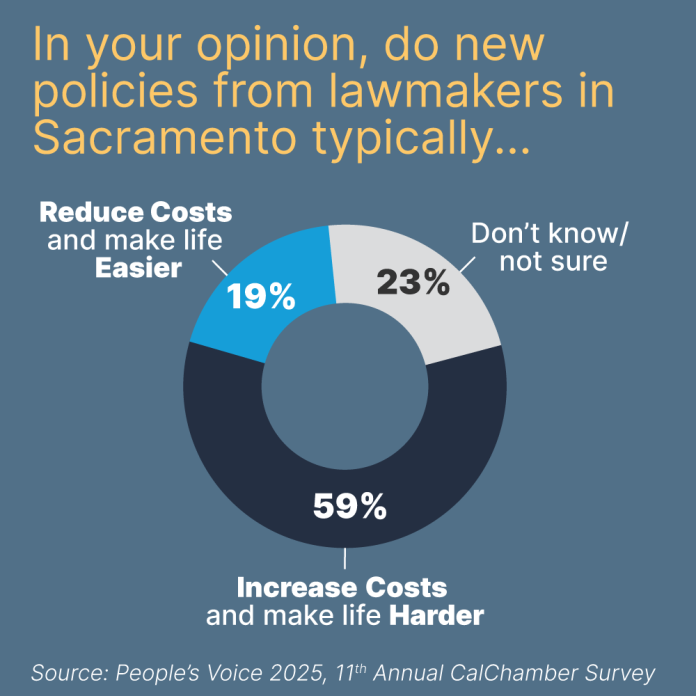
The Affordability Agenda highlights legislation that helps businesses and consumers by cutting costs, as well as those policies that will drive costs up as Californians struggle with the high cost of living.
When Businesses Thrive, Californians Prosper
Our government is at its best when elected officials seek ways to cut costs, but it is most damaging when lawmakers add more business and consumer burdens that will drive costs higher.
Issues related to affordability have remained a concern for voters in the annual CalChamber poll. Employers, employees, and families deserve to know whether lawmakers are helping California’s economy to grow… or holding it back. An essential question should be asked about every bill introduced in the California Legislature: What impact will this have on the cost of living in the Golden State?
Affordability in California starts with a strong economy. That means keeping costs down, ensuring steady job growth, and never losing sight of ways to keep consumer confidence high.
2026 Cost Cutters
As part of CalChamber’s Affordabilty Agenda, each year a list of Cost Cutter bills is released to identify legislation that reduces costs for businesses and consumers. CalChamber tracks these bills throughout the legislative session and works to educate legislators about the positive effect these bills will have on the state.
AB 2124 (Pacheco; D-Downey) Improves How the Legislature Evaluates the Cost of Energy Policy Decisions through Independent Ratepayer Impact Review. Supports more cost-effective policymaking by creating a framework for independent evaluation of proposed legislation that imposes costs on utility customers, helping identify unnecessary or duplicative programs and reducing future rate pressure. Vetoed.
AB 1693 (Zbur; D-Hollywood) Accelerated Building Plan Approval.Tenant Improvements. Streamlines permitting for tenant improvements at retail locations, while ensuring compliance with all applicable building, health, and safety requirements. Signed—Chapter 827.
SB 84 (Niello; R-Fair Oaks) Right to Cure. Provides businesses with time to cure an alleged Americans with Disabilities Act (ADA) violation to curb frivolous litigation. Two-Year Bill. In Assembly policy committee 6/18/2025. Failed deadline to pass Assembly policy committee 7/2/2026.
AB 2366 (Ávila Farías; D-Martinez)Requires State Agencies to Consider Fiscal Impacts on Cost of Living. Requires state agencies as well as the Legislative Analyst’s Office to evaluate regulations to determine their fiscal impact on cost of living in California, ensuring affordability is a consideration when the state is evaluating proposed new regulations. Held in Assembly Appropriations Committee 5/14/2026.
AB 1606 (Nguyen; D-Elk Grove) Cleanup Costs Tax Credit. Provides a tax credit for businesses that incur expenses to remove unauthorized encampments, illegal dumping, and abandoned property from commercial properties in California. Held in Assembly Appropriations Committee 5/14/2026.
AB 2205 (Quirk-Silva; D-Fullerton) New Employment Tax Credit. Reinstates California’s New Employment Credit (NEC), which has been uniquely effective in incentivizing businesses to hire full-time employees in designated census tracts and economic development areas. Held in Assembly Appropriations Committee 5/14/2026.
2026 Cost Drivers
As part of CalChamber’s Affordabilty Agenda, each year a list of Cost Driver bills is released to identify legislation that will decimate California’s economic and job growth, and increase costs for small businesses and consumers. CalChamber tracks these bills throughout the legislative session and works to educate legislators about the serious consequences these bills will have on the state.
SB 1075 (Reyes; D-San Bernardino) New Permitting Barriers for Job-Creating Projects in Disadvantaged Communities. Creates new permitting barriers and opportunities for frivolous California Environmental Quality Act (CEQA) litigation for commercial and industrial projects in disadvantaged communities, increasing uncertainty for job-creation and risking tax-base erosion. Held in Assembly Appropriations 8/13/2026.
AB 1777 (Garcia; D-Rancho Cucamonga) Grants California Air Resources Board (CARB) Sweeping New Authority to Regulate Indirect Sources Statewide. Authorizes broad, undefined statewide regulation of facilities that attract mobile sources of emissions, driving new compliance costs across key sectors and increasing prices for goods and services. To Assembly Inactive File 5/28/2026.
SB 1074 (Wiener; D-San Francisco) Sweeping Change to State's Antitrust Law. Would have a chilling effect on the development of digital tools used by California consumers and small businesses. Failed passage in policy committee; reconsideration granted 4/20/2026.
AB 1776 (Aguiar-Curry; D-Winters) Significant Expansion of Antitrust Law. As introduced, created an unprecedented expansion of antitrust law, leaving every business of every size in California vulnerable to massive legal liability. Cost Driver status removed with amendments removing the bill’s most damaging components, but CalChamber remained opposed due to concerns about the new liability standards and the bill’s incompatibility with federal antitrust law. Signed—Chapter 826.
AB 2170 (Boerner; D-Encinitas) CEQA Expansion. Proposes to eliminate CEQA exemptions and ministerial review processes if certain types of projects are sited near "overburdened communities" and forces all environmental review documents to be translated into other languages, thereby exposing lead agencies and project applicants to new litigation liability. Held in Assembly Appropriations Committee 5/14/2026.
AB 2569 (Hart; D-Santa Barbara) CEQA Expansion. Significantly expands California Environmental Quality Act (CEQA) environmental impact report requirements, which will increase litigation exposure and costs for a permitting process that already causes some of the longest and most costly project delays in the country. Held in Assembly Appropriations Committee 5/14/2026.
SB 982 (Wiener; D-San Francisco) Drives Up the Cost of Energy Through a Punitive Strict Liability Framework for Climate Damages. Requires a targeted group of energy companies to absorb substantial costs for climate-related damage regardless of fault, enforced through actions brought by the Attorney General, costs that will be reflected in higher prices for energy and everyday goods. Failed passage in policy committee 4/22/2026.
SB 875 (Wiener; D-San Francisco) Removes Key Legal and Regulatory Safeguards that Protect Ratepayers in Utility Takeover Decisions. Weakens established safeguards in utility takeover decisions by limiting judicial and regulatory review, exposing ratepayers to higher costs and increased system risk. Failed passage in policy committee 4/21/2026.
SB 1011 (McNerney; D-Pleasanton) Limits Use of Technology by Utilities. Places significant burdens on utilities' use of automated decision systems, which would impact systems already in widespread use to manage distribution systems as well as critical systems used to provide rapid emergency responses. To Senate Inactive File 5/28/2026.
AB 2447 (Bauer-Kahan; D-Orinda) Infeasible Mandates on Nitrogen Fertilizer Application. Imposes scientifically unsupported, legislatively mandated deadlines on California farmers before the State's own expert panel has finished determining what is even achievable — threatening thousands of agricultural jobs, driving up food costs for California families, and dismantling the very programs currently providing safe drinking water to affected communities. Held in Assembly Appropriations Committee 5/14/2026.
AB 1900 (Kalra; D-San Jose) Government-Run Health Care. Forces all Californians into a new untested state government health plan, with no ability to opt out while eliminating Medicare for California seniors and increasing taxes at least $250 billion a year on workers, income, jobs, goods and services. Never assigned to policy committee 4/24/2026.
AB 1979 (Bonta; D-Alameda) Artificial Intelligence in Health Care. Imposes overly broad, disruptive oversight requirements on health facilities using AI tools. Prevents unlicensed individuals from using AI tools. Includes unworkable liability provisions. Recent amendments relieve burdensome oversight requirements and replace liability requirements with more reasonable liability/oversight. Opposition and Cost Driver tag removed with 7/2/2026 amendments. CalChamber Neutral. Signed—Chapter 854.
AB 2575 (Ortega; D-San Leandro) Discourages Artificial Intelligence in Health Care. Requires unworkable disclosure requirements for using AI tools in a health care setting. Places complete liability for harm of patient on health care entities and developers if using AI-enabled tools. Vetoed.
SB 947 (McNerney; D-Pleasanton) Restricts Use of Automated Decision Systems in Employment. Imposes impractical requirements on employers of every size related to automated decision systems, which will discourage the use of such tools and subject employers to costly penalties and onerous new compliance procedures. Cost Driver tag removed due to 8/21/2026 amendments narrowing the bill to apply only to disciplinary or termination employment decisions, but CalChamber still opposes. Signed—Chapter 859.
SB 951 (Reyes; D-San Bernardino) Discourages Innovation Through Broad AI Layoff Mandates. Significantly expands Cal/WARN type requirements to include impacts on hiring or staffing as a result of technology and includes problematic enforcement provisions that allow uninterested, third parties to file claims. Cost Driver tag removed due to 8/21/2026 amendments that narrowed notice requirements, but CalChamber still opposes. Signed—Chapter 860.
AB 1234 (Ortega; D-San Leandro) Creates New Penalty and Revises Wage Claim Procedures. Imposes up to a 30% penalty on all orders issued by the Labor Commissioner, which penalizes employers that exercise their due process rights, and also makes other burdensome changes to the existing claims process. Two-Year Bill Introduced in 2025. On Senate Inactive File since 9/3/2025. Failed to advance before the end of the legislative session.
AB 1331 (Elhawary; D-Los Angeles) Restricts Workplace Safety and Security Tools. Undermines workplace safety in every California workplace by effectively prohibiting the use of surveillance technology in the workplace, including security cameras, cybersecurity systems, and anti-theft devices. Two-Year Bill Introduced in 2025. On Senate Inactive File since 9/13/2025. Removed from Inactive File 8/21/2026. Cost Driver tag removed due to 8/21/2026 amendments narrowing the bill to cover only bathrooms in a workplace, but CalChamber still opposes. Signed—Chapter 851.
AB 1898 (Schultz; D-Glendale) Onerous Notice Requirement. Requires public and private employers of all sizes to issue a voluminous number of notices regarding even the most routine technologies and for those notices to include confidential and proprietary information. The bill also effectively gives all employees and independent contractors veto power over the employer deploying new technology. Held in Assembly Appropriations Committee 5/14/2026.
AB 2027 (Ward; D-San Diego) Creates Barriers to Technology Investment and Job Growth. Its sweeping provisions effectively prohibit creating or improving technology used in the workplace, impacting everything from simple scheduling tools to life-saving technology developments in health care. Held in Assembly Appropriations Committee 5/14/2026.
AB 2064 (Sharp-Collins; D-San Diego) Significantly Limits Ability to Consider Criminal History in Employment. Exposes California employers to costly litigation and liability by adding "criminal history" as a protected class under both the Unruh Civil Rights Act and the Fair Employment and Housing Act, stripping businesses of the ability to make reasonable hiring and customer-service decisions based on an individual's past criminal conduct. Held in Assembly Appropriations Committee 5/14/2026.
AB 2095 (Lee; D-San Jose) Expands Fair Chance Liability and Restricts Employer Hiring Discretion. Creates problematic changes to the Fair Chance Act, including a presumption that an applicant may not be denied a position if they have completed a sentence or possess a certificate or license for the position, regardless of the facts or circumstances of any prior convictions. To Assembly Inactive File 5/28/2026.
AB 2646 (Krell; D-Sacramento) Drives Up Agricultural Labor Costs and Threatens California Farm Competitiveness. Threatens the H-2A program, which many agriculture employers rely on to fill labor shortages, by creating a minimum wage of $19.75 for any H-2A worker or worker performing comparable work in that same county. This will drive up agricultural costs at a time when the industry can least afford it. Signed—Chapter 956.
AB 2564 (Ward; D-San Diego) Litigation Risks for Offering Discounts. Exposes companies who offer discounts to potential liability for offering basic, consumer-friendly discounts if they fail to fit into the bill's three, limited, allowable forms of discounts. Also infringes on the California Consumer Privacy Act (CCPA) by creating new disclosure obligations that businesses must comply with in order to use personally identifiable information to offer discounts, despite the CCPA already having such standards for rewards programs. Failed to advance before the end of the legislative session.
SB 259 (Wahab; D-Hayward) Online Pricing. Originally prohibited businesses from using any input data to create prices or discounts. Forces companies to overhaul their pricing models and strategies at significant cost, to the detriment of both the businesses themselves and their consumers. This threatened not only the profitability of businesses, but also potentially reduced the availability of discounts and personalized deals for consumers. Two-Year Bill Introduced in 2025. Amended to remove surveillance pricing provisions 8/20/2026, and include language related to vote by mail ballots. Based on these amendments, CalChamber moved to neutral. Signed—Chapter 331.
SB 295 (Hurtado; D-Bakersfield) Pricing Algorithms. Prohibits a person from using or distributing pricing algorithms that use, incorporate, or were trained on "nonpublic competitor data." Exposes businesses to significant uncertainty and aggressive liability and creates a chilling effect on the use of this technology by imposing significant cost on all businesses using technological tools. Two-Year Bill Introduced in 2025. Failed passage in Assembly, 9/13/2025, 13-24. Reconsideration granted. Failed to advance before the end of the legislative session.
AB 1018 (Bauer-Kahan; D-Orinda) Impact Assessments of Automated Decision Systems. Limits use of automated decision systems (ADS), including by small businesses, which will lead to significant liability and increased costs that will ultimately be borne by consumers. It would also hinder many beneficial uses of ADS, including but not limited to: enabling faster approvals and expanded access to credit and enhancing real-time fraud detection. Two-Year Bill Introduced in 2025. Removed from Senate Inactive File 8/21/2026. Failed to advance before the end of the legislative session.
AB 2021 (Schiavo; D-Chatsworth) CCPA Whistleblower Incentives. Creates a financial incentive for individuals to bring forward claims of violations under the California Consumer Privacy Act (CCPA), effectively deputizing employees and consumers as private attorneys enforcing the CCPA. This Private Attorneys General Act (PAGA)-like litigation diverts agency resources and circumvents the deliberate enforcement structure created in the CCPA. Failed deadline to move from policy committee 4/24/2026.
AB 2034 (Addis; D-Morro Bay) New Costly Regulatory Structure. Establishes extensive, state-specific regulatory structure regarding food additives that will significantly impact supply chains and increase food costs. Held in Assembly Appropriations Committee 5/14/2026.
SB 1123 (Wiener; D-San Francisco) Remove Detailed Economic Analysis from California Regulations. Effectively ends the existing obligation for agencies to perform thorough economic analysis of any regulation that has over $50 million in economic effects by allowing agencies to skip the analysis if they assert that the long-term economic or health impacts outweigh the economic costs. Failed deadline to pass Assembly policy committee 7/2/2026.
AB 1790 (Connolly; D-San Rafael) Significant Tax Increase for International Businesses. Forces all taxpayers to file on a worldwide combined reporting basis. Requires businesses to report revenues from international affiliates and subject their tax liability to income generated in foreign countries. Assembly fiscal committee postponed hearing 5/14/2026.
SB 632 (Arreguín; D-Berkeley) Expands Costly Presumption of Injury. Significantly increases workers' compensation costs for public and private hospitals by presuming certain diseases and injuries are caused by the workplace and establishes an extremely concerning precedent for expanding presumptions into the private sector. Has been tried nine times before and failed every time. Two-Year Bill Introduced in 2025. Referred to Assembly Insurance Committee 6/16/2025.Amended to focus on a new policy issue and therefore failed to move forward as a Cost Driver 6/10/2026.