
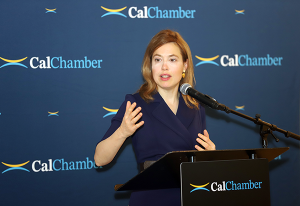
Relations between the United States and Europe are in a transition phase, Alexandra de Hoop Scheffer, president of the German Marshall Fund of the United States, told a breakfast gathering of the CalChamber Council for International Trade (CCIT) on December 5.
California-Europe relations are an important part of reinventing the transatlantic relationship, de Hoop Scheffer said at the meeting, which was led by CCIT Vice Chair Jennifer Haley of Kern Energy.
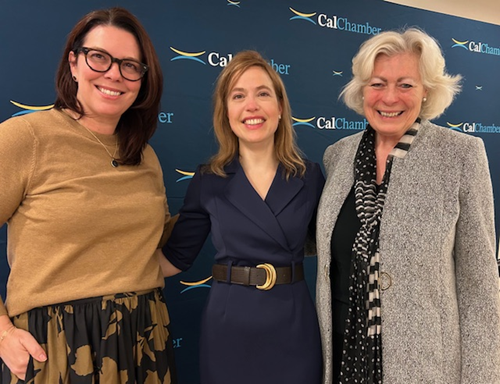
Attendees included the consuls general from Canada, the United Kingdom, the Netherlands, Ukraine, Portugal, the Slovak Republic, the Czech Republic and Bulgaria, as well as representatives of the European Chamber of Commerce.
Geopolitical Transition
The war in Ukraine has led to a European reassessment of relations with the United States and other nations, de Hoop Scheffer commented. Part of the rebalancing, she said, includes recognizing the need for Europe to be less dependent on U.S. defense, Russian energy, and Chinese technology.
She encouraged listeners to read President Trump’s recently released 2025 National Security Strategy. A quick review, de Hoop Scheffer said, indicates the strategy is to narrow American priorities, equate economic security with national security, and focus on the Western Hemisphere first, Asia second and Europe third.
The strategy calls for Europe to take on a greater share of the burden of its defense, while cooperating with the United States in areas where interests overlap, such as critical minerals supply.
Strong Economic Relations
What keeps the U.S. relationship with Europe strong is record high transatlantic trade and investment, de Hoop Scheffer explained. She pointed out that U.S.-European Union trade in goods and services reached $2 trillion in the past year — far exceeding U.S. trade with China.
Many U.S. technological services companies see the European market as the most profitable, and Europe also works a lot with U.S. defense companies.
The interdependence between the United States and Europe continues to grow, she said. The U.S. and Europe are the primary source and destination for foreign direct investment (FDI), together accounting for 60% of global inward foreign investment stock and 62% of outward stock in 2024.
California-Europe
European companies are the source of high-quality jobs in California, said de Hoop Scheffer. For example, the United Kingdom is the largest source of FDI and Germany is the third largest. European Union investment is responsible for 30,000 jobs in California, mainly in technology, finance and professional services.
To revamp the transatlantic relationship, she said, will require strengthening state-local connections, city-to-city connections, and lawmaker-to-lawmaker connections.
As political tensions grow between the United States and Europe, cultivating other channels, including business-to-business connections, can produce advantages for companies, she said.
California is working already with European nations in areas such as climate, technology innovation, artificial intelligence, and standards setting, according to de Hoop Scheffer.
She encouraged the audience to “interact with your European counterparts because this business-to-business relationship is absolutely going to shape this new transatlantic relationship, and hopefully in a much more pragmatic way and a much more creative way. This is an era where we need to be creative together.”
The German Marshall Fund of the United States (GMF) is a nonpartisan and nonprofit organization focused on transatlantic affairs. The GMF was founded as an independent American foundation in 1972 with a gift from Germany in appreciation for aid received under the Marshall Plan after World War II.
Headquartered in Washington, D.C., the GMF offers insight into policy and political dynamics across the Atlantic and beyond, and retains offices throughout Europe.
Staff Contact: Susanne T. Stirling