
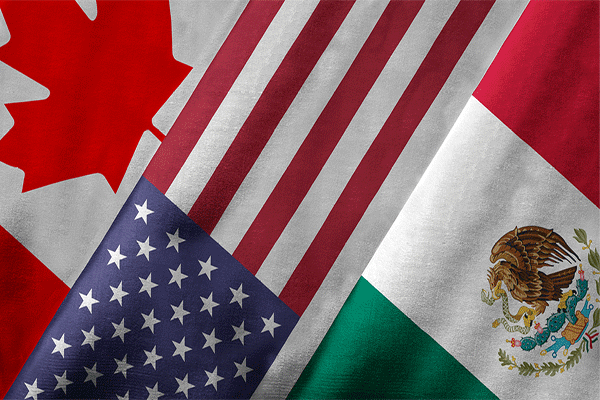
 The California Chamber of Commerce joined more than 500 chambers and associations from all 50 states last week in signing a coalition letter to U.S. Trade Representative (USTR) Ambassador Jamieson Greer in support of the U.S.-Mexico-Canada Agreement (USMCA).
The coalition submitted the letter while the USTR was holding three days of hearings to prepare for a mandatory review of the USMCA in 2026. Nearly 150 individuals representing a variety of organizations testified during the three days.
The USMCA law signed by President Donald Trump in January 2020 requires the USTR to produce a report based on the hearings at least 180 days (January 2, 2026) before top trade officials from the United States, Canada and Mexico meet on July 1, 2026 for the first Six-Year Joint Review to decide whether they want to renew the pact for another 16-year term.
Separately, President Trump spoke privately (presumably about trade matters) with Canadian Prime Minister Mark Carney and Mexican President Claudia Sheinbaum at the draw for the 2026 FIFA World Cup at the Kennedy Center in Washington D.C. on Friday, December 5. The three countries are co-hosting the 2026 World Cup.
Previously, the CalChamber submitted public comments on November 3, as the Office of the U.S. Trade Representative was starting the public consultation process in advance of the joint review of the USMCA.
Beneficial to Business, Society
Since the early 1990’s, the CalChamber has supported the concept and establishment of a North American Free Trade Agreement (NAFTA) based upon an assessment that it serves the employment, trading and environmental interests of California and the United States, as well as Canada and Mexico, and is beneficial to the business community and society as a whole.
That support continued during the first Trump administration when the United States, Mexico and Canada reached an agreement to modernize the 25-year-old NAFTA into a 21st century, high-standard agreement.
The CalChamber continues to believe the USMCA supports mutually beneficial trade leading to freer markets, fairer trade, and robust economic growth in North America.
Now as all three countries have begun to organize for the six-year USMCA review in July 2026, the CalChamber continues to support the objectives of the USMCA to eliminate barriers to trade, promote conditions of fair competition, increase investment opportunities, provide adequate protection of intellectual property rights, establish effective procedures for implementing and applying the agreements and resolving disputes, and to further trilateral, regional and multilateral cooperation.
The process, which begins in year six of the pact (2026), allows each country to either confirm its desire to extend the agreement or raise concerns that it wants to address. In the latter scenario, the three countries will continue the review every year until either the concerns are resolved, or the pact is terminated in year 16.
Given California’s position as a global leader in international trade, the USMCA priorities are important to CalChamber members and the overall economic health of our state.
USMCA Statistics
The United States, Canada and Mexico comprise more than 520 million people (6.3% of the world’s population), more than $33 trillion in gross domestic product (GDP) (nearly 30% of world GDP), and $1.8 trillion in goods and services trade (5.5% of $33 trillion in total global trade). More than 13 million American jobs depend on trade with Mexico and Canada. The USMCA provides duty-free access for nearly all goods traded among the three countries.
The importance of total U.S.-USMCA goods trade at $1.601 trillion cannot be overstated. The $683.94 billion in exports to Mexico and Canada include transportation equipment ($116.69 billion), computer and electronic products ($80.47 billion), chemicals ($69.03 billion), non-electrical machinery ($63.99 billion), and petroleum and coal products ($49.06 billion).
Total U.S. imports from Mexico and Canada of $917.41 billion include transportation equipment ($238.95 billion), oil and gas ($117.91 billion), computer and electronic products ($104.75 billion), electrical equipment, appliances and components ($54.13 billion), and non-electrical machinery ($52.51 billion).
CalChamber Position
The original key provisions of the USMCA, including focus on rules of origin, goods market access, intellectual property modernization, ease of customs and trade rules for small business, greater market access for American agriculture, strong disciplines on digital trade, and enforceable labor standards, are as important to the agreement today as they were when first implemented. Through all these provisions the continued theme of compliance and enforcement should run.
The CalChamber urges the Trump administration to continue to engage with Mexico and Canada and swiftly extend the USMCA. In fact, it is hoped that the continued success of the USMCA may serve as a foundation for future trade agreements around the world.
The USMCA creates a stable and certain commercial environment that reinforces strong economic ties and enhances North American competitiveness in the global market, thereby ensuring North American economic security, which leads to geopolitical security.
Staff Contact: Susanne T. Stirling