

Trading Partner Portal: Kenya
Overview
California and Kenya join in a historic partnership to curb emission and boost trade
Governor of California, September 25, 2025
Memorandum on the Designation of Kenya as a Major Non-NATO Ally
The White House, June 24, 2024
United States-Kenya Joint Leaders’ Statement
The White House, May 23, 2024
Kenya: President Ruto’s U.S. State Visit Marks Major Milestone and Investment Opportunity
allAfrica.com, May 16, 2024
Trade Overview
 The Republic of Kenya is located on the eastern coast of Africa, bordered by South Sudan to the northwest, Ethiopia to the north, Somalia to the east, Uganda to the west, Tanzania to the south, and the Indian Ocean to the southeast.
The population of Kenya totals 56.43 million people as of 2024, per the U.S. Department of Commerce with the official languages of the country being English and Swahili, with other dialects through out the region. Many ethnic groups speak their mother tongues within their communities. Kenya is classified as a lower-middle-income economy and is the largest economy in eastern and central Africa with a GDP of $124.5 billion in 2024. Nairobi, Kenya’s capital, serves as the major commercial hub.
U.S. – Kenya Trade
In February 2020, the U.S. announced its intent to negotiate a trade agreement with Kenya. This would be the first agreement with a sub-Saharan African country.
Total U.S.-Kenya two-way trade currently reached over $1.51 billion in 2024, with the U.S. exporting $771 million worth of goods to Kenya. Oil and gas made up the largest export category at $190 million. This was followed by transportation equipment ($168 million), chemicals ($166 million), computer and electronic products ($66 million), and paper ($33 million).
Imports from Kenya into the U.S. totaled $737 million in 2024. Apparel and accessories made up the largest portion at $533 million of the total. The next largest imports were agricultural products ($92 million), goods returned ($28 million), processed foods ($24 million), and (U.S. Department of Commerce)
California – Kenya Trade
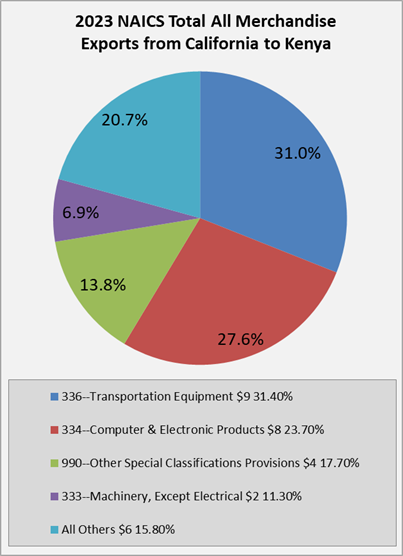
In 2024, California exported $38 million worth of goods to Kenya. Top exports included computer and electronic products ($15 million), transportation equipment ($9 million), chemicals ($3 million), other special classification provisions ($3 million), and non-electrical machinery ($2 million).
In 2024, California imported $58 million worth of goods from Kenya, $23 million of which was made up apparel and accessories. This was followed by agricultural products ($19 million), goods returned ($8 million), processed foods ($5 million), and livestock and livestock products ($2 million). (U.S. Department of Commerce)
FDI – Kenya
U.S. foreign direct investment into Kenya totaled $163 million in 2024. Bureau of Economic Analysis
More Articles:
The Nairobi-Washington Vision
The White House, May 23, 2024
Trade Agreements
Trade Agreements
| U.S. Strategy Toward Sub-Saharan Africa White House, August 2022 FACT SHEETVital Partners, Shared Priorities: The Biden Administration’s Sub-Saharan Africa Strategy U.S. Food Security Assistance to Sub-Saharan Africa Statement by President Biden on the U.S.-Africa Leaders Summit |
2024 BIENNIAL REPORT ON THE IMPLEMENTATION OF THE AFRICAN GROWTH AND OPPORTUNITY ACT
United States Trade Representative, June 2024
USTR Releases Summaries from U.S.-Kenya Strategic Trade and Investment Partnership Negotiations
U.S. Trade Representative, May 23, 2023
Biden Administration Launches U.S.-Kenya Strategic Trade and Investment Partnership
CalChamber, July 15, 2022
Statement by Ambassador Katherine Tai on the Launch of the United States-Kenya Strategic Trade and Investment Partnership
U.S. Trade Representative, July 14, 2022
United States and Kenya Announce the Launch of the U.S.-Kenya Strategic Trade and Investment Partnership
U.S. Trade Representative, July 14, 2022
U.S. Chamber Releases In-Depth Analysis of Potential U.S.-Kenya Free Trade Agreement
U.S. Chamber, April 28, 2021
REPORT: U.S.-Kenya Trade Negotiations: Implications for the Future of the U.S.-Africa Trade Relationship
U.S. Chamber, April 2021
VIDEO
The United States and Kenya: Strategic Partners
U.S. Department of State, April 27, 2021
The U.S. and Kenya Launch Negotiations on a Free Trade Agreement: Will They Succeed?
US Chamber, July 29, 2020
Joint Statement Between the United States and Kenya on the Launch of Negotiations Towards a Free Trade Agreement
U.S. Trade Representative, July 8, 2020
United States – Kenya Negotiations: Summary of Specific Negotiating Objectives
U.S. Trade Representative, May 2020
U.S. Takes Next Step in Pursuit of Free Trade Agreement with Kenya
CalChamber, March 24, 2020
Trump Administration Notifies Congress of Intent to Negotiate Trade Agreement with Kenya
U.S. Trade Representative, March 17, 2020
Letter to Congress
President Trump Announces Intent to Negotiate Trade Agreement with Kenya
U.S. Trade Representative, February 6, 2020
FACT SHEET: U.S.-Kenya Trade and Investment Relationship
U.S. Chamber: ‘Fully Supports Pursuit of a Comprehensive, High-standard Trade Agreement with Kenya’
U.S. Chamber, February 6, 2020