Trade Prosperity in Uncertain Times Depends on Cross-Border Partnerships
In keeping with World Trade Month, the California Chamber of Commerce is highlighting its long-held support for a national free trade agenda and the significance of international trade in maintaining economic growth.
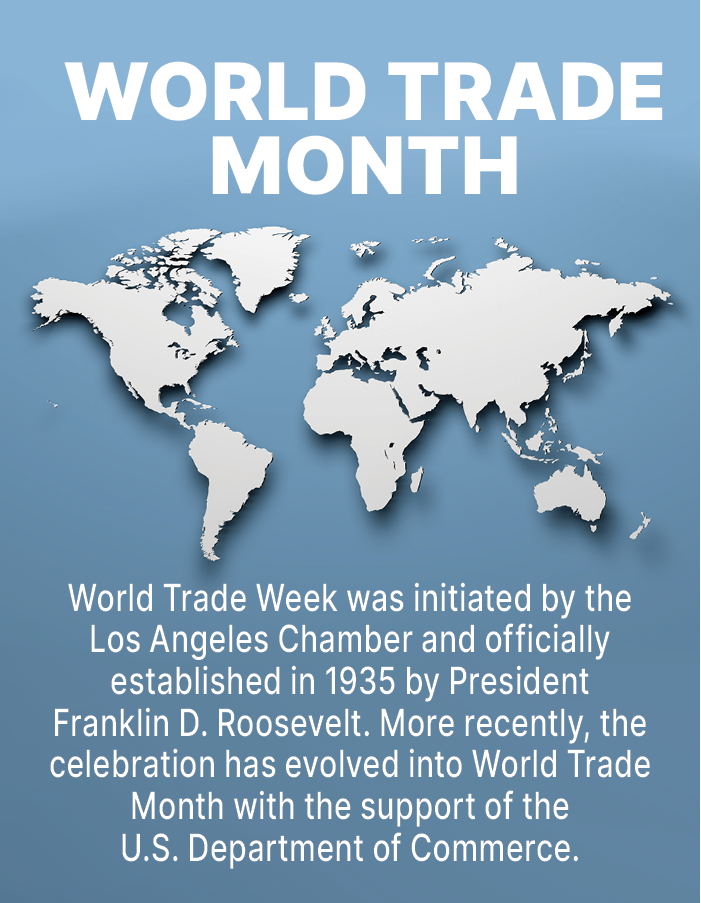
Fittingly, the month-long focus on trade began as World Trade Week in California in 1926. President Franklin D. Roosevelt proclaimed the week a national observance in 1935.
World Trade Month activities provide opportunities to acknowledge the importance of global trade to the economies of California and the United States and celebrate how international trade unlocks new business opportunities, creates jobs, and strengthens the U.S. and global economy.
National Trade Policy Agenda
Earlier this year, President Trump released his annual 2026 Trade Policy Agenda emphasizing an America First Trade Policy. For 2026, the U.S. Department of Commerce, specifically the International Trade Administration, is focusing on fostering strategic, secure and inclusive trade. The department also underscores the importance of international trade for economic growth, job creation, and business expansion.
Since World War II, the world has been in an era of globalization and trade liberalization. Income and exports have grown, and extreme poverty has decreased. The United States has developed free trade agreements with Australia, Bahrain, Chile, Colombia, Central America, Israel, Jordan, Mexico and Canada, Morocco, Oman, Panama, Peru, Singapore, and South Korea. These free trade agreements translate into the removal of billions of dollars in tariffs and nontariff barriers for U.S. exports.
Since 1944, countries have relied on a set of trade rules, first under the auspices of the General Agreement on Tariffs and Trade and since 1993, on the more updated World Trade Organization (WTO).
The WTO is the only global international organization dealing with the rules of trade between nations. Unfortunately, the WTO is faltering. Trading partners do not always adhere to the rules — leaving the 166 WTO governments, which together account for 98% of world trade, struggling with uncertainty.
In a world where the President promised the most disruptive change in Washington, D.C. ever seen, there are increasing changes in the rules of order, trade disruption, geopolitical competition, and supply chain upheaval. There is no doubt that trade is a top-tier issue.
Subnational Commercial Diplomacy
The global changes put California and CalChamber in a unique position to encourage interest in and understanding of international trade as a vital part of our economy. Too often the positive impact of international commerce on our state’s economy is taken for granted, without considering that in 2025, California exported $188.40 billion in goods to roughly 227 foreign economies. California’s top export markets are Mexico, Canada, Taiwan, Japan and China.
California’s nominal gross domestic product (GDP) reached $4.25 trillion in 2025, placing California behind only the United States, China, Germany and Japan in global rankings. California is currently the fifth largest economy in the world.
Although trade is a nationally determined policy issue, its impact on California is immense. Trade offers the opportunity to expand the role of California’s exports. In its broadest terms, trade can literally feed the world and raise the living standards of those around us.
Through subnational commercial diplomacy, we continue to place value on our trade and investment relationships with many partners across the globe. These cross-border partnerships are developing at a rapid rate and ultimately support the growth of markets and expand prosperity for all. Our trading partners become friends for the good of all.
CalChamber Position
The CalChamber will continue to focus on lowering and eliminating tariff and nontariff barriers to support the expansion of American exports. The CalChamber opposes protectionist measures which create uncertainty, disrupt global supply chains, raise consumer prices, limit choices of products for consumers, hinder the competitiveness of California businesses, and invite retaliation.
The CalChamber believes strengthening economic ties and enhancing regulatory cooperation through agreements with our top trading partners that encompass both goods and services, including financial services, is essential to eliminating unnecessary regulatory divergences that may act as a drag on economic growth and job creation.
The CalChamber seeks commercially meaningful outcomes in negotiations with regions around the world and supports bilateral, regional and multilateral trade agreements, which are critical to consumers, workers, businesses, farmers and ranchers, and would allow the United States to compete with other countries that are negotiating agreements with each other.
California’s economy is diverse, and the state’s prosperity is tied to exports and imports of both goods and services by California-based companies, to exports and imports through California’s transportation gateways, and to movement of human and capital resources.
International trade and investment are major parts of our economic engine that broadly benefit businesses, communities, consumers and state government. We need to recognize this not only each May, but every month of the year.
Susanne T. Stirling is senior vice president of international affairs for the California Chamber of Commerce.
Author