

Trading Partner Portal: United Arab Emirates
Overview
Trade Overview
 The United Arab Emirates enjoys a high per capita income and an open economy with a substantial trade surplus. Oil was discovered in the UAE in the 1950s and Abu Dhabi was one of the first emirates to begin exporting oil. Since the discovery and export of oil, the UAE has transformed into an economy with a high standard of living. The UAE has been a member of the WTO since 1996 and a member of GATT since 1994. The UAE has a population of approximately 41.1 million and a nominal GDP of $2.22 trillion as of 2024. (U.S. Department of Commerce, World Bank)
U.S. – UAE Trade
Two-way goods trade between the United States and the UAE was approximately $39.02 billion in 2025.
The United States exported $31.42 billion in goods to the UAE in 2025. Top exports consisted of transportation equipment ($9.15 billion), computer and electronic products ($6.67 billion), primary metal manufactures ($2.17 billion), miscellaneous manufactures ($2.17 billion), and used or second-hand merchandise ($1.92 billion).
Goods imports from the UAE to the U.S. were over $7.61 billion, with the top categories being primary metal manufacturing ($1.93 billion), goods returned ($1.35 billion), chemicals ($912 million), oil and gas ($725 million), and petroleum & coal products ($471 million).
UAE – California Trade
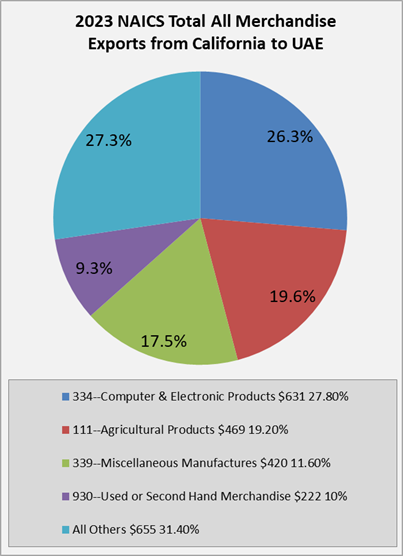
In 2025, California exported $2.70 billion to the UAE, with agricultural products making up $698 million of the total. This was followed by computer and electronic products ($621 million), used or secondhand merchandise ($291 million), transportation equipment ($255 million), and miscellaneous manufactures ($192 million).
Goods imports for this same year totaled at $1.13 billion, with oil and gas being the top product category going to the U.S. at $697 million, roughly 61.7% of the total. Other top imports included primary metals manufactures ($137 million), reimports ($79 million), petroleum and coal products ($49 million), and miscellaneous manufactures ($37 million). California is the #2 importer from the UAE out of all 50 states.
FDI – UAE
U.S. FDI in the UAE totaled $15.24 billion in 2024, and UAE FDI into the U.S. totaled $35.32 billion in the same year. UAE FDI contributed to 33,200 jobs in the U.S. And $1.5 billion went to expanding U.S. exports from Emirati-owned firms. Roughly 1.9 billion was invested in research and development as well.
The top industry sectors for UAE FDI were business services, communications, transportation, software & IT services, real estate, and food and beverages. Select USA, Bureau of Economic Analysis
More Articles:
UAE Ready ‘Anytime’ for Free Trade Talks with U.S.
Politico, August 4, 2022
Abraham Accords
(Per the Dubai Chamber and the Federation of Israeli Chambers Joint Partnership, 2020) The “Abraham Accords” created a historic opportunity for Bi –literal cooperation between the countries, which led to the signing of a strategic partnership agreement between the Dubai Chamber of Commerce and The Federation of Israeli Chambers of Commerce, early this September. Under the agreement, the parties open up to the business sectors in both countries in order to increase and expand business connections, promote mutual trade and encourage investments.
Press Release: Dubai Chamber of Commerce and Industry and the Federation of the Israeli chambers of Commerce launch their first joint economic study
Dubai Chamber and the Federation of Israeli Chambers, November 23, 2020
The economic works are an integral continuation of this cooperation that was forged between the two chambers and is now paving the way for future investments and trade.
1. Joint Economic Paper prepared with the Dubai Chamber of Commerce – Click here to read the document
The economic research work outlines the potential inherent in the collaboration between the business sector in Dubai and the business sector in Israel.
2. Research Paper on the Emeriti Business Economy – Click here to read the document
A research paper that drew a basic road map of the Emeriti economy that includes: Key Emeriti stakeholders and the main driving forces in the economy and business culture in the Emirates. The paper includes: