

Trading Partner Portal: Egypt
Overview
Trade Overview
 Egypt spans the northeast corner of Africa and is considered a Mediterranean country. Egypt is considered a cradle of civilization, as it’s able to trace its history back longer than any other country. Islam is the official religion of Egypt and Arabic the official language, although there is a significant Christian minority in the country. The population of Egypt is 116.54 million, making it the most populous country in North Africa, the Middle East, and the Arab world, and the third most populous in Africa. The Sahara Desert makes up large regions of Egyptian land.
Egyptian GDP was $389.06 billion in 2024. Its economy is the second or third largest in Africa, in competition with South Africa, and one of the largest and most diversified in the Middle East. (Bureau of Economic Analysis).
U.S. – Egypt Trade
U.S. exports to Egypt in 2024 totaled $6.30 billion. This included $1.21 billion worth of oil and gas. Other top exports included agricultural products ($1.15 billion), chemicals ($1.09 billion), transportation equipment ($844 million), and minerals & ores ($375 million)
The U.S.’s imports from Egypt were $2.55 billion in 2024, with apparel and accessories totaling $1.20 billion. This was followed by processed foods ($401 million), chemicals ($240 million), primary metals manufactures ($163 million), and textile mill products ($136 million). U.S. Department of Commerce
California – Egypt Trade
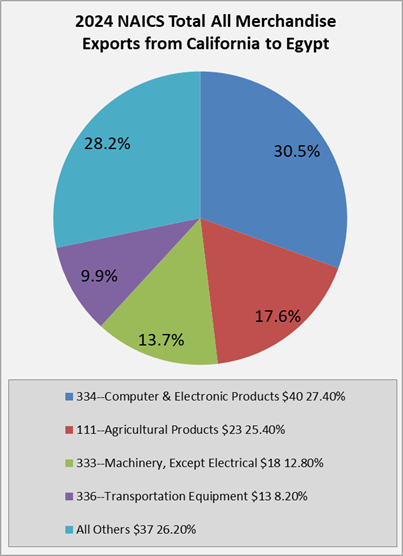
California exports to Egypt totaled $131 million in 2024, with computer and electronic products as the largest export category at $40 million. This was followed by agricultural products ($22 million), non-electrical machinery ($18 million), transportation equipment ($13 million), and processed foods ($8 million).
Imports from Egypt to California totaled $222 million in 2024, $91 million of which was processed foods. Other top imports included apparel and accessories ($74 million), textile mill products ($15 million), chemicals ($10 million), and nonmetallic mineral products ($9 million). U.S. Department of Commerce
FDI – Egypt
In 2024, the U.S invested $11.9 billion in Egypt, an almost 2.8% increase from 2023.
Trade Agreements
Trade Agreements
Events
Events