

Trading Partner Portal: Portugal
Overview
Trade Overview

Portugal lies on the Atlantic coast in southwestern Europe, with Spain as its neighbor and surrounding its entire boarder. It is closely tied, culturally and geographically, with its Mediterranean and European neighbors. It hosts a variety of climates from coastlines, mountains, and lowlands, and has nearby island autonomous archipelagos of Maderia and the Azores. Its capital city Lisbon is the cultural and economic center, as it has a rich maritime history. Britannica
Portugal is classified as a high-income country that has developed a strong service market-based economy that accounts for approximately 66% of its GDP. In 2024, its population totaled 10.7 million people, with nominal GDP at $308.68 billion. Like other European countries, a great deal of Portugal’s trade is within Europe and surrounding countries; however, the United States is Portugal’s fourth largest export destination. Travel services, renewable energy, and tourism have been key industries in economic growth since the Covid-19 pandemic, with renewable energy expected to grow by 20% by 2026. OEC World, Statista, U.S. Department of Commerce.
U.S. – Portugal Trade
The U.S. exported roughly $2.96 billion to Portugal in 2024, with Portugal being the U.S. 57th export market. Top 5 exports for Portugal were oil and gas ($1.25 billion), transportation equipment ($477 million), agricultural products ($309 million), chemicals ($220 million), and computer and electronic products ($148 million).
In this same year the U.S. imported $6.78 billion in products from Portugal, with Portugal being 48th in U.S. import markets. The top imports were chemicals ($1.93 billion), petroleum and coal products ($1.06 billion), plastics and rubber products ($457 million), apparel and accessories ($417 million), and computer and electronic products ($346 million). U.S. Department of Commerce
Portugal – California Trade
California continues to be the state with the largest Portuguese population. About 350,000 Portuguese Americans live in California, with most from the Azores islands. The first wave of Azorean immigrants came in the late 1900s to 1920s seeking better opportunities in America. On the west coast in California there are Portuguese communities in San Francisco, Oakland, San Jose, Santa Cruz, as well as in dairy farming areas in the Central Valley, the Los Angeles Basin, and San Diego, in connection to Portuguese fishermen and settlers emigrating to California from the Azores. The oldest company in Portugal is Azores Airlines.
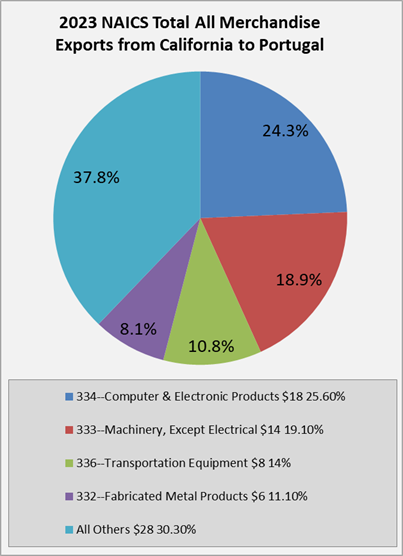
California is also one of the top U.S. states for exporting and importing for Portugal. In 2024, California exported a total of $89 million in products to Portugal, with top products being computer and electronic products ($22 million), non-electronic machinery ($13 million), fabricated metal products ($7 million), chemicals ($7 million), and electrical equipment, appliances, & components ($6 million). U.S. Department of Commerce
Imports from Portugal were a total of $544 million. Top products were plastics & rubber products ($160 million), wood products ($135 million), apparel & accessories ($45 million), leather & allied products ($28 million), and furniture and fixtures ($23 million). trade.gov
FDI – Portugal
The foreign direct investment position from the U.S. into Portugal was roughly $1.65 billion in 2024. Portugal FDI dd not have any reportable position as of 2024, but has supported 1,600 jobs, invested $56.2 billion in innovative research and development, and contributed $24 million to expanding U.S. exports. Key sectors for investment would be in energy, software and IT services, hotels and tourism, pharmaceuticals, and business services. Select USA
Trade Agreements
Trade Agreements and Issues
Portugal has many trade agreements through its membership with the EU, which gives it free trade agreements with EU member countries, and outside agreed upon treaties. Through the customs union it has trade agreements with New Zealand, Singapore, South Korea, Japan, the U.S., and others. It is also currently negotiating and renegotiating with China, Chile, the Philippines, and Singapore.
Portugal has steadily beat expectations for economic growth within the EU, however, is does face issues of possible overvalued real estate and increased interest rates as of 2023. The CFP, Public Finance Council has also noted that productivity growth is a large concern macroeconomically, as it could mean low wages for Portuguese workers. U.S businesses may also face issues of competition with European companies, as they will know the business culture and not have the same the tariffs and regulations. There are currently issues with low birth rates and a growing number of an aging workforce, which can have long-term consequences on the economy.
Transatlantic Trade and Investment Partnership (TTIP)
Portugal is one of the nations that is currently involved in negotiations for the Transatlantic Trade and Investment Partnership (TTIP) with the rest of the European Union and the United States. The United States and the European Union have a strong bilateral trade relationship totaling $698.7 billion in 2015. A free trade agreement, such as TTIP, desires to strengthen that relationship by eliminating tariffs, aligning compatible regulations to open trade, and furthering trade in the service sector.
Events
Events
Azores Delegation Visits CalChamber for Portuguese Heritage Month

The California Chamber of Commerce hosted a gathering with representatives having Azores connections.
Present at the June 24, 2024, meeting was Artur Lima, the vice president of the Azores, who was visiting Sacramento for the presentation of Assembly Concurrent Resolution (ACR) 205 (Aguiar-Curry; D-Winters) in honor of Portuguese Heritage month.
Also present were Diniz Borges, president of the California Portuguese-American Coalition, and Cliff Costa, vice president of California Advocates.
Greeting the delegation was Susanne T. Stirling, CalChamber senior vice president of international affairs.
ACR 205 establishes June as Portuguese Heritage month, recognizing June 10 as the Day of Portugal and May 20 as the Day of the Azores. The measure honors the continued influences of Portugal and the Azores communities in California that have established themselves and contribute to the state and its economy.