

Trading Partner Portal: Jordan
Overview
Trade Overview

Jordan is a small country in the Middle East between Israel and Iraq. The capitol of Jordan is Amman. Jordan has a population of 11.55 million people and gross domestic product (GDP) of $53.35 billion. Though the World Bank classifies Jordan as an upper-middle income country, it has one of the smallest economies in the Middle East. Therefore, Jordan has retained a heavy reliance on foreign trade and assistance for resources and economic stability. For example, the United States had approximately $156 million of foreign direct investment flow into Jordan in 2020 (Bureau of Economic Analysis).
U.S. – Jordan Trade
In the early 2000’s, King Abdullah II of Jordan expanded foreign trade relationships to bolster Jordan’s economy. He began trade deal discussions and privatized state-owned companies to attract investment. The United States and Jordan established a free trade agreement, and it was put in full effect in 2010. The United States is one of Jordan’s top trading partners, with two-way trade totaling $5.39 billion in 2024.
The United States exported $2.03 billion of products to Jordan in 2024, with $519 million of goods being transportation equipment. This was followed by $447 million of used or secondhand merchandise, oil and gas ($234 million), processed foods ($129 million), and chemicals ($107 million). U.S. Department of Commerce
The United States imported $3.36 billion worth of goods from Jordan in 2024. The largest category of imported goods from Jordan into the United States is apparel and accessories which totaled $1.88 billion. Other top goods included miscellaneous manufactures ($948 million), chemicals ($273 million), non-electrical machinery ($100 million), and goods returned ($66 million).
Jordan – California Trade
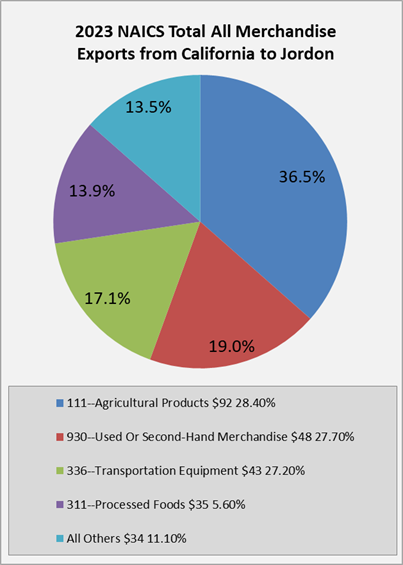
In the U.S., California is the largest exporter to Jordan. In 2024, California exported $283 million worth of products to Jordan. Agricultural products were the largest export category, making up $99 million of the total. Other key exports from California were processed foods ($59 million), used or secondhand merchandise ($51 million), transportation equipment ($33 million), and non-electrical machinery ($7 million). U.S. Department of Commerce
California imported around $306 million worth of goods from Jordan in 2024. The majority of those imports were apparel and accessories, which made up $178 million of the total. Other major imports from Jordan to California were non-electrical machinery ($75 million), miscellaneous manufactures ($42 million), processed foods ($3 million), and beverage and tobacco products ($2 million). U.S. Department of Commerce.
FDI – Jordan
The U.S. direct investment position in Jordan as of 2024 was roughly $190 million.
More Articles:
Posting First Rise Since 2014, U.S. Exports to Arab World Grow 4 PErcent to $62.64 Billion in 2019
National U.S.-Arab Chamber of Commerce, February 9, 2020
U.S. Goods Exports to Arab Countries 2018 vs. 2019
National U.S.-Arab Chamber of Commerce, February 2020
Trade Agreements
Trade Agreements and Issues
The United States- Jordan Free Trade Agreement
The United States and Jordan have sustained a mutually beneficial trade relationship with the United States- Jordan Free Trade Agreement with its initial enactment in 2002 and full implementation by 2010. This agreement coincides with the Qualifying Industrial Zones established in 1996. Jordan, along with some other countries in the Middle East, are able to export products that were manufactured in their country into the US duty-free. The US-Jordan Free Trade Agreement has established intellectual property protection for both countries, reduced trade barriers for services, effective production protections for labor and the environment, and has made regulation more transparent across borders. Since the implementation, there has been major economic progression for the US and Jordan. For the US, the automobile exports to Jordan have risen by 1500%, corn exports have increased by 2300%, and TV and radio transmitters have increased by 500%.
US Middle East Free Trade Initiative
USTR Jordan Free Trade Agreement