

Trading Partner Portal: Bulgaria
Overview
Rose festival brings thousands of tourists to Bulgaria- Video
Associated Press, June 4, 2024
Visa Application Centers in the USA
Embassy of Bulgaria, April 25, 2024
Largest US trade and investment delegation to visit Bulgaria in recent years
Sofia Globe, October 21, 2023
Trade Overview
 Bulgaria is a European country in southeastern part of Europe, specifically in the Balkan Peninsula. One of the oldest European countries, it is surrounded by Romania to the north, Serbia and North Macedonia to the west, Greece and Turkey to the south, and the Black Sea to the east. It enjoys climates attributed to its lowland plains, the Balkan Mountains, and the coastal regions at the Black Sea, all of which give it a diversity in its economic prospects.
As of 2024, Bulgarian nominal GDP hit $112.21 billion, with its population totaling around 6.44 million people. Its top industries being agriculture, agricultural machinery and equipment, environmental technologies, and energy. Bulgaria also has a small niche in rose oil production, with the Bulgarian rose oil being highly popular in many cosmetics due to the uniqueness of its production and cultivation. The rose oil production also attracts many tourists to the annual Rose Festival year-round.
Bulgaria shifted from a centralized economy that it saw during after the fall of the Soviet Union, to a now middle-income, market-based structure. It has switched to an open economy and holds free trade agreements with many countries. Bulgaria is a member of the European Union, joining in 2007, and became a NATO country in 2004, with many EU members engaging in the majority of Bulgarian trade. Being a newer member of the EU, Bulgaria is considered an emerging market. It has not yet adopted the euro, and while having plans to do so, no date or timeline is set.
trade.gov
U.S. – Bulgaria Trade
Two-way trade between Bulgaria and the U.S. totaled $1.97 billion in 2024. U.S. exporting with Bulgaria totaled $482 million, with Bulgaria being ranked 106th among U.S exporters. Top U.S exports to Bulgaria were transportation equipment ($125 million), non-electrical machinery ($85 million), computer and electronic products ($81 million), chemicals ($41 million), and petroleum and coal products ($24 million).
In this same year, U.S imports from Bulgaria totaled $1.49 billion with top imports being computer and electronic products ($217 million), primary metals manufactures ($203 million), non-electrical machinery ($150 million), chemicals ($143 million), and miscellaneous manufactures ($134 million).
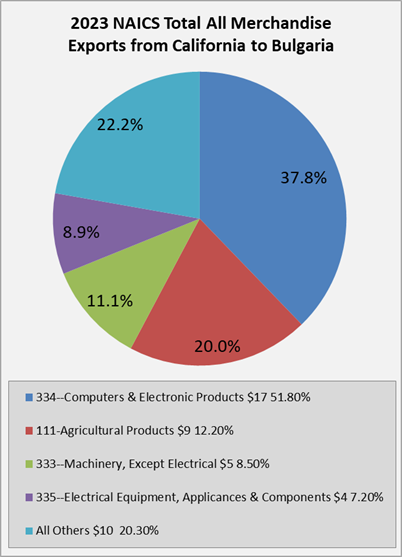
Bulgaria – California Trade
Bulgaria ranked 88th in California exports, totaling $45 million in 2024. The top exports to Bulgaria from California were computer and electronic products ($15 million), agricultural products ($9 million), non-electrical machinery ($7 million), transportation equipment ($4 million), and miscellaneous manufactures ($3 million).
Meanwhile, imports from Bulgaria totaled $105 million, with top 5 imports being computer and electronic products ($23 million), processed foods ($18 million), transportation equipment ($10 million), apparel and accessories ($8 million), and non-electrical machinery ($8 million).
FDI – Bulgaria
During 2024, the U.S. direct investment position was $469 million in Bulgaria. Bulgarian FDI in the United States was $106 million.
bea.gov
Bulgaria and the World
Bulgaria is ranked 54 among world exporters, with over $50.2 billion exports worldwide, and ranked 52 among importers, with imports totaling $58.1 billion. While also being a member of the EU and NATO, Bulgaria joined the World Trade Organization in 1996 and the Central European Free Trade Agreement (CEFTA) in 1999, later leaving CEFTA for the European Union. It currently holds free trade agreements with EU member countries and countries outside of the EU. U.S-Bulgarian interests are currently active with the U.S having an American Chamber of Commerce in Bulgaria for roughly 28 years, which has united American, Bulgarian, and multinational companies that are currently operating in the country (AmCham, Bulgaria). They also have a U.S Commercial Service center in the capital city of Sofia, located in the U.S. Embassy, which helps U.S companies conduct business with Bulgarian interests.
trade.gov
Trade Agreements
Trade Agreements and Issues
Bulgaria has multiple trade agreements with many countries. Being a member of the EU, they have open trade with their member countries under the European Free Trade Area (EFTA) and have trade agreements negotiated through the EU. They also joined the Central European Free Trade Agreement, or CEFTA, in 1999 but turned over membership when they joined the EU but continue to have agreements with some CEFTA members. It currently holds free trade agreements with China, Turkey, Macedonia, Israel, Albania, Serbia, and Montenegro; all are outside of the EU.
Trading issues one may experience when conducting business with Bulgaria, are regulatory and legislative issues, a slow court system, difficulty acquiring construction permits, low purchasing power, and corruption in some areas of the country’s economic sectors. Political instability in recent years has made economic development slow, and one very large issue Bulgaria has been facing, as with much of Europe, is the ongoing war with Ukraine.
Despite the issues it faces, recovery is in sight through incentive and programs provided by the EU through EU post-COVID recovery grants and export increases.
Key Country Contacts
Resources
- American Chamber of Commerce in Bulgaria
- Bulgarian Honorary Consulate – Sacramento
- Consulate General of Bulgaria – Los Angeles
- U.S. Commercial Service Bulgaria
- American University in Bulgaria