

Trading Partner Portal: Brazil
Overview
Modifying the Scope of Tariffs on the Government of Brazil
The White House, November 20, 2025
California and Brazil ink new climate partnership to cut pollution, protect public health, strengthen economy
Governor of California, September 23, 2025
Trade Overview
 Brazil is one of the 5th largest countries in the world, with its geographical size almost as large as the U.S., it is the largest country in South America. It has the largest swath of the Amazon River basin and has inland boarders with all other South American countries except Chile and Ecuador.
It boasts a population of 212.5 million people and a nominal GDP of $2.19 trillion, making it one of the strongest economies in South America, with leading sectors being agriculture, manufacturing, and mining. The U.S. and Brazil have multiple initiatives to engage in trade, one being the 2011 Agreement on Trade and Economic Cooperation, which expands direct trade between the two countries. This was also updated under the Trump administration on October 19, 2020. São Paulo is currently the country’s top financial sector, and the primary city for international business. U.S. Trade Representative
U.S – Brazil Trade
In 2025 two-way trade between the U.S. and Brazil was $94.32 billion, with total exports trade of $54.38 billion in exports to Brazil. Top exports were transportation equipment ($12.40 billion), chemicals ($12.27 billion), petroleum & coal products ($7.62 billion), computer & electronic products ($5.59 billion), and non-electrical machinery ($4.22 billion).
U.S. imports to Brazil totaled $39.94 billion in 2025. Top imports being primary metals manufactures ($6.05 billion), oil and gas ($5.13 billion), processed foods ($4.88 billion), goods returned ($3.31 billion), and transportation equipment ($2.78 billion).
Total services trade between the U.S. and Brazil in 2025 was $40.51 billion, with exports totaling $33.28 billion. Top services exported from the U.S. to Brazil were travel, charges for intellectual property use, other business services, telecommunications, computer, & information services, and transport services.
Imported services from Brazil to the U.S. totaled $7.23 billion, with top imports being other business services, transport services, travel, telecommunications, computer, & information services, and financial services.
California – Brazil Trade
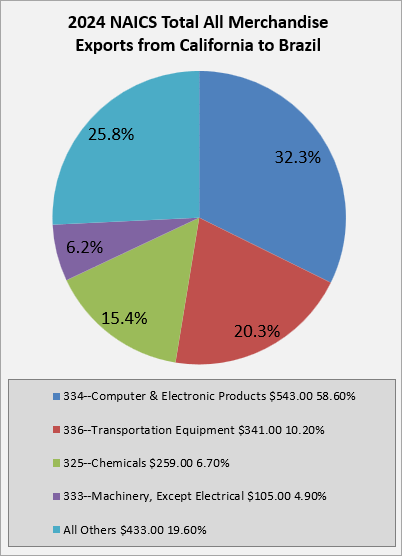
Brazil is ranked 25th in California’s top trading partners with exports from California totaling $1.85 billion. Top exports were computer and electronic products ($656 million), chemicals ($330 million), transportation equipment ($250 million), non-electrical machinery ($115 million), and fabricated metal products ($93 million).
Imports from Brazil to California totaled $5.76 billion in 2025, a 20% decline compared to 2024. Top imports were, oil and gas ($3.84 billion), processed foods ($531 million), primary metals manufactures ($424 million), agricultural products ($211 million), and goods returned ($156 million).
FDI – Brazil
Brazil FDI stock in the U.S. totals $37.9 billion, as of 2024. Brazilian FDI is supports 104,700 U.S. jobs and has worked to expand U.S. exports an estimated $7.8 billion. Likewise, FDI into Brazil from the U.S. totaled $87.96 billion, making the U.S. the largest foreign investor in Brazil. Top industries include software & IT services, financial services, food & beverages, business services, chemicals, and communications.
Related News
Joint Statement from President Donald J. Trump and President Jair Bolsonaro
White House, March 7, 2020
Statement by the Press Secretary on the Meeting with President Jair Bolsonaro of Brazil
White House, March 6, 2020
Joint Communique from the U.S.-Brazil CEO Forum
U.S. Department of Commerce, November 25, 2019
Message to the Congress on Designating Brazil as a Major Non-NATO Ally
White House, May 8, 2019
Joint Statement from President Donald J. Trump and President Jair Bolsonaro
White House, March 19, 2019
Other News:
Brazilian Ministry of the Environment: Adopt-A-Park Program
February 10, 2021
A Path to Boost International Trade Between Brazil-California – Official Catalog
Brazil-California Chamber of Commerce, November 10-11, 2020
Brazil to Join OECD in a Year, Plans ‘Digital Bank’ IPO
Reuters, October 20, 2020
Preliminary Overview of the Economies of Latin America and the Caribbean
ECLAC, December 2019
Trade Agreements
Trade Agreements and Issues
Brazil is a part of the MERCOSUR customs union which unites many Latin American countries to have an easier flow of goods through reduced tariffs or free trade agreements. Brazil currently has free trade agreements with Bolivia, Colombia, Egypt, Peru, Chile, and Israel through MERCOSUR. It also has framework agreements with Mexico and Morocco through this customs union.
The EU and Brazil are currently negotiating a free trade agreement under the EU’S Association Agreement negotiations. This is incredibly significant because Brazil and the EU have very close economic ties, with the EU being Brazil’s second largest economic partner and Brazil the EU’s eleventh. European Commission
The U.S. and Brazil also have close economic ties, with both countries signing the 2011 Agreement on Trade and Economic Cooperation, which strengthens the trading relationship by allowing a framework to work on a variety of issues like innovation and trade barriers.
It is important to note that doing business in Brazil can be costly as it has strict labor laws, and its tax system is complicated to outside firms. However, Brazil has been moving forward to reforms to make it easier to do business in Brazil, such as aligning its tax system with its international partners.
Agreement on Trade and Economic Cooperation
In the Fall of 2020, the U.S. and Brazil reached an agreement on an update to the 2011 Agreement on Trade and Economic Cooperation (ATEC). President Trump and Brazilian President Jair Bolsonaro had directed the two countries to work towards an agreement in March of 2020. The new agreement included a protocol on trade regulations and transparency. This included three new annexes: customs administration and trade facilitation to reduce bureaucracy in foreign trade; good regulatory practices for the convergence of rules; and anti-corruption measures. (Brazil-U.S. Business Council, U.S. Chamber)
The negotiations also established two new economic partnerships. The first is a memorandum of understanding between the Brazilian Ministry of Economy and the Export–Import Bank of the United States (EXIM), and the second is involves the U.S. International Development Finance Corporation (DFC), which announced a commitment to invest USD 425 million in two projects in Brazil. (Brazil-U.S. Business Council, U.S. Chamber)
Brazil – U.S. Joint Statement on Enhancement of Bilateral Economic and Trade Partnership
U.S. Trade Representative, April 17, 2020
White House, March 7, 2020
On March 19, 2011, President Obama and President Rousseff signed the Agreement on Trade and Economic Cooperation, to enhance cooperation on trade and investment between the Western Hemisphere’s two largest economies.
Investment
Investment
Foreign investment in Brazil continues from many countries, with the U.S and Brazil continuing close investment through the Agreement on Trade and Economic Cooperation. Both countries invest significantly in each other, with the 2022 FDI from Brazil totaling $4.2 billion in 2022. Likewise, FDI into Brazil from the U.S. totaled $81 billion. Brazil has become the largest investor in the U.S. from South America as of 2022. SelectUSA
In 2018, US FDI in Brazil was $70.8 billion. Brazil FDI in the United States had a negative was $39 billion in 2018 (BEA). According to the USTR, U.S. FDI in Brazil is led by the manufacturing and finance/insurance sectors and Brazil’s FDI in the United States is led by the wholesale trade sector. In 2017, Brazil FDI in the U.S. supported 85,400 jobs. Brazil invested $17 million into research and development in the U.S. Brazil also invested $4.4 billion into expanding U.S. exports. The top industry sectors in the US of Brazilian FDI are: software and IT services, financial services, food and beverages, textiles, chemicals, and metals. SelectUSA
Other News and Resources:
Vice President Biden Discusses the ‘Start of a New Era of U.S.-Brazilian Relations’
Remarks to the Press by Vice President Biden and Brazilian Vice President Temer
General Council appoints Azevêdo as next Director-General, Lamy pledges smooth transition
Joint Statement by President Obama and President Rousseff
Fact Sheet: The United States and Brazil: A Growing Partnership
Fact Sheet: The U.S.-Brazil Economic Relationship
Fact Sheet: The U.S.-Brazil Global Partnership Dialogue
Fact Sheet: U.S.-Brazil Science and Technology Cooperation
Fact Sheet: The U.S.-Brazil Strategic Energy Dialogue
Fact Sheet: U.S.-Brazil Defense Cooperation
Fact Sheet: Strengthening the U.S.-Brazil Economic Relationship
Fact Sheet: the United States and Brazil Facilitating Travel and Exchange
Related News


Key Country Contacts
Resources
CalChamber Resources
Business
Business
Cultural
Cultural/Educational