

Trading Partner Portal: Bolivia
Overview
Paraguay and Bolivia sign key cooperation agreements
Merco Press, June 13, 2024
Bolivia is the latest South American nation to use China’s yuan for trade in challenge to the dollar
Associated Press, July 27, 2024
Trade Overview
Bolivia is a central-South American country, bordered by Brazil, Argentina, Peru, Chile, and Paraguay, and is only one of two South American landlocked countries. Roughly one-third of the country is in the Andes Mountain range, and it also hosts a variety of different climates. It is rich in minerals including zinc, lithium, silver, and tin, with its lithium deposits being largely untouched. Its agricultural sector is growing quickly, and an important part of its growing economy.
With a population of just over 12 million people, Bolivia has a GDP of $48 billion. Bolivia is the second poorest country in South America; however, it has the had the fastest growing economy in terms of GDP. Main economic and exporting centers in Bolivia would be in the large cities of Santa Cruz, La Paz, El Alto, and Cochabamba, with a large part of the population living in these cities and much of its international business being conducted in these places. Bolivia has trade agreements with its neighbors and trades with a variety of other countries.
Bolivia – U.S Trade
In 2025, two-way trade between Bolivia and the U.S. totaled $967 million, with U.S exports to Bolivia totaling $348 million. Top exports were transportation equipment ($67 million), chemicals ($59 million), computers and electronic products ($59 million), non- electrical machinery ($55 million), and petroleum & coal products ($21 million).
Imports from Bolivia to the U.S. totaled $619 million in the same year. he top five imports being primary metals manufactures ($344 million), agricultural products ($87 million), chemicals ($63 million), minerals and ores ($51 million), and wood products ($18 million).
California – Bolivia Trade
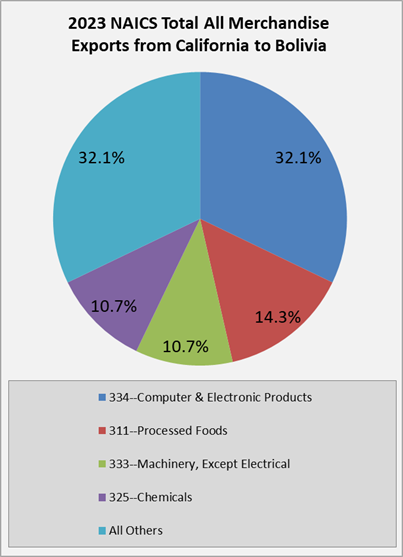
In 2025, California exported $23 million to Bolivia, with top exports being chemicals ($6 million), processed foods ($6 million), computer and electronic products ($4 million), non-electric machinery ($1 million), and miscellaneous manufactures ($1 million).
California imported a total of $49 million in products from Bolivia, with top imports being agricultural products ($31 million), primary metals manufactures ($7 million), paper ($4 million), computer and electronic products ($2 million), and wood products ($2 million).
FDI- Bolivia
In 2024, U.S FDI entering Bolivia totaled at $172 million, while $20 million was invested from Bolivia into the United States. Leading sectors for U.S exports and investments were energy, equipment and machinery, automobiles, healthcare, and agriculture. (International Trade Administration)
Trade Agreements
Trade Agreements
Trade Agreements and Issues
Bolivia is affiliated with the General Agreement on Tariffs and Trade (GATT), Andean Community (CAN), MERCOSUR, and WTO. It also has complimentary agreements with Chile (ACE 22), Panama, Cuba, and Mexico (ACE). These agreements eliminate tariffs and most trade barriers with the affiliated countries. Bolivia in the past was allowed duty free access or reduced duty rates under the General System of Preferences (GSP) for it is exports to the EU, Switzerland, Canada, Russia, Australia, U.S and others. GSP expired in 2020. It currently does not have a free trade agreement with the U.S.
The Bolivian government enforces a state centered economic plan, which makes it challenging to do international business for many countries and firms. The country also faces political instability, as well as conflicts within its main political party MAS (Movement Towards Socialism). Economic instability attributes primarily to its growing fiscal deficit, which is primarily derived from fuel import subsidies, and overspending. Lack of judicial help, corruption, and mirky investment incentives also make it difficult for foreign direct investment.
Events
Events