
Trading Partner Portal: Argentina
Overview
Fact Sheet: President Donald J. Trump Ensures Affordable Beef for the American Consumer
The White House, February 6, 2026
Joint Statement on Framework for a United States-Argentina Agreement on Reciprocal Trade and Investment
The White House, November 13, 2025
Trade Overview

Argentina is a nation that takes up most of the southern part of South America, it is the eighth largest nation in the world in terms of land mass, and the second largest in South America. It has many climates including deserts, tundra’s, forests, plains, mountains, and coastlines, with the Andes mountains, Patagonia and the Pampas being the most notable regions.
Argentina is surrounded by its neighbors of Chile to the west, Brazil and Uruguay to the east, Paraguay and Bolivia to the north, and the Atlantic Ocean on its eastern coasts.
With a population of 47.2 million people, it is one of South Americas largest economies, with many living in its urban cities including the capital of Buenos Aries.
Its nominal GDP was $604 billion in 2024, with its key economic sectors being agriculture, mining, and energy. While it faces many challenges, Argentina’s economy has the benefit of a large and educated workforce with information technology being an emerging sector in the economy.(Britannica, U.S Department of Commerce)
U.S – Argentina Trade
In 2025, the U.S. exports to Argentina totaled at $9.90 billion, with two-way trade totaling $18.19 billion. Top U.S. exports for Argentina included chemicals ($2.31 billion), computer & electronic products ($1.57 billion), petroleum and coal products ($1.44 billion), transportation equipment ($882 million), and non-electrical machinery ($1.24 billion).
Within this same year the U.S imported $8.29 billion in goods from Argentina. The top five imports being oil and gas ($2.54 billion), primary metals manufactures ($1.57 billion), processed foods ($1.25 billion), petroleum & coal products ($628 million), and chemicals ($448 million).
Services trade between the U.S and Argentina totaled $11.67 billion, with exports totaling $8.80 billion. Top exports were travel, transport services, other business services, financial services, and charges for intellectual property use.
Services imports from Argentina to the U.S. totaled $ 2.87 billion, with top imported services being travel, other business services, transport services, charges for intellectual property use, and telecommunications, computer, & information services.
California – Argentina Trade
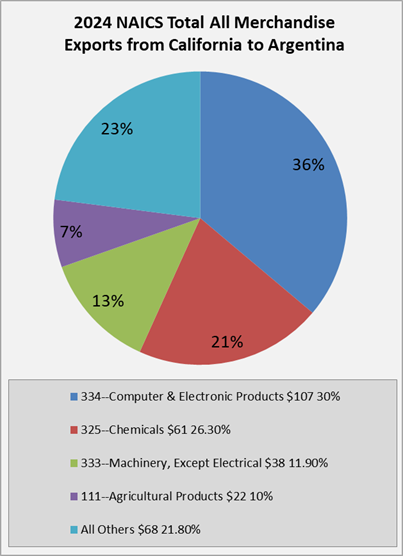
In 2025, Argentina ranked 43rd for California in export destinations, with exports totaling $385 million. Top products exported were computer and electronic products ($161 million), chemicals ($72 million), non-electrical machinery ($50 million), agricultural products ($29 million), and miscellaneous manufactures ($22 million).
Imports to California from Argentina in 2025 totaled $2.18 billion, with top imports being oil & gas ($1.78 billion), processed foods ($167 million), fish & other marine products ($77 million), agriculture products ($50 million), and beverages & tobacco products ($42 million). U.S. Department of Commerce
FDI- Argentina
The FDI for Argentina into the U.S. in 2024 came in at about $555 million, while U.S investment into Argentina was $12.1 billion. The top industries Argentina has invested in are software & IT services, business services, communications, transportation, industrial equipment, and financial services. FDI from Argentina has provided around 10,400 jobs in the U.S. with roughly $221 million to expand U.S. exports. BEA
Update:
Argentina’s Struggle for Stability
Council of Foreign Relations, February 5, 2024
Yes, Really: It’s Time to Revive Hemispheric Trade Talks
Latin Trade, August 6, 2020
Argentina, Once Shunned, Regains Its Allure Wall Street Journal May 27, 2015
World Trade Organization (WTO) Case
On August 21, 2012 the U.S. Trade Representative Ron Kirk formally requested consultations with the Government of Argentina under the dispute settlement provisions of the World Trade Organization (WTO)
Consultations are the first step in the WTO dispute settlement process. Under WTO rules, if the matter is not resolved through consultations within 60 days, the United States may request the establishment of a WTO dispute settlement panel. See a copy of the U.S. consultation request here
Japan also requested WTO consultations with Argentina on this matter today, and the European Union requested consultations in May of this year.Mexico has launched its first dispute against Argentina at the World Trade Organization, accusing it of protectionism, a move that follows similar complaints by the European Union, United States and Japan.
US companies value the trading relationship with Argentina and are desirous of creating jobs and growth. Current Argentine government trade policy does create an obstacle, however, pending WTO consultations should promote dialogue to improve the relationship. See a summary of the dispute settlement here
Obama Declares a New Partnership After Talks With Argentine Leader
President Obama on March 23, 2016 declared a fresh era of partnership between the United States and Argentina, saying he stood ready to support Mauricio Macri, the country’s new president, in his bid to improve the nation’s economy and credibility on the world stage.
Remarks by President Obama and President Macri of Argentina at Parque de la Memoria
White House, March 24, 2016
FACT SHEET: United States – Argentina Relationship
White House, March 24, 2016
United States and Argentina Sign Trade and Investment Framework Agreement
USTR, March 23, 2016
Trade Agreements
Trade Agreements
Trade Agreements
Argentina has many longstanding trading relationships with its most important being with the U.S, other Latin American countries, and MERCOSUR. The Southern Common Market or MERCOSUR is one the most important, because most of Argentina’s free trade agreements are through this customs union, with the most notable being the EU, South African Customs Union, and the European Free Trade Association.
It is a founding member of the Association for Latin American Integration (ALADI), which is an organization with the long-term goal of establishing a Latin American common market. Through ALADI, Argentina works with neighboring Latin American countries to establish a multitude of trade agreements. They are also members of the World Trade Organization (WTO) and became member in 1995, (oas.org).
Argentina also has many trade agreements with countries around the world including, the U.S, E.U., Latin America, and others. One of its largest trading partners has become China, as Argentina has leaned on China for both trade, foreign direct investment, and infrastructure. Just recently in 2022, Argentina signed with the Chinese Belt and Road Initiative, to help with infrastructure.
With the U.S, Argentina has the free trade agreement TIFA, or the Trade and Investment Framework, which allows for internal discussion of trade and commercial issues from 2016. They signed a MOU to support small and medium enterprise and development, and the Digital Economy Working Group, which establishes commercial dialogue between the Ministry or Production and the Department of Commerce. They are also an important non-NATO ally with the U.S and is one of few Latin American countries that hold this title.
Issues
While Argentina is one of the largest economies in South America, it does face issues internally. Of the most notable issues are the uncertainty of the economy, climate change, and corruption. Argentina continues to face issues with high inflation, currency depreciation, a growing national debt, and political unrest, all of which have made their economy face volatility. Climate change has also had a growing impact on the Argentine agricultural market, with persistent drought causing a variety of issues with production and distribution. Issues with the agricultural sector also has far reaching affects, as Argentina is the world’s 3rd largest food exporter. Lastly, corruption continues to create issues in a variety of sectors including in political, regulatory, and financial, all of which has been the cayuse fir many large-scale protests in the country in recent years.
Santa Fe Province
Santa Fe Province and the State of California
California and Santa Fe have an ongoing reciprocal exchange program, which began in 2004 between the California Senate International Relations Foundation and the Fundación Nueva Generación Argentina (FNGA). The goal is to increase political and economic ties, as well as discuss specific public policy issues including sustainable energy, port security and goods movement, and public safety.
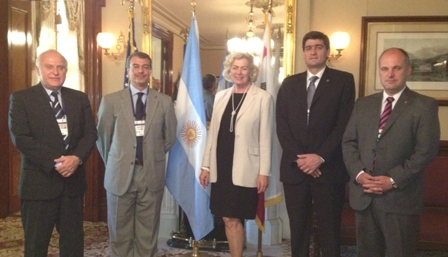
Atop-level delegation from Santa Fe Province visited California in August 2012. Santa Fe Lieutenant Governor Henn led the delegation and was accompanied by government officials and major business and trade representatives.
Of the 23 provinces in Argentina, the Santa Fe Province has one of the most important economies in the country, accounting for nearly 10 percent of the nation’s output.More than 20 percent of the cultivated lands of Argentina are in Santa Fe, whose main crops include soybeans, sunflowers, maize, wheat and rice. Strawberries, honey and cotton are also produced. In addition, 20 percent of the nation’s livestock in meat and dairy are in the province.
Santa Fe is located inland northeast of Buenos Aires. The main river and connection to the Atlantic Ocean is the Parana River—one of the largest in the world. Manufacturing is also important in Santa Fe, with mills, refineries and steel production.The main city and capital of Santa Fe is Rosario, with a population of more than3 million.
In addition to Santa Fe’s lieutenant governor and key senators, the delegation was very interested in establishing private sector contacts. The Nueva Generacion Argentina Foundation, founded in 1990 in Rosario, has been researching and fighting for strengthening and consolidating democracy and the institutions of the republic, spreading the culture of democracy as a value and principle to improve the population’s welfare and quality of life. The FNGA is a nonprofit, independent and nonpartisan organization.
The Foundation has a strong international vision and is working to form a special relationship with Californians interested in exchanges in the academic, commercial, cultural and sporting areas. In particular, there is interest in strengthening commercial exchanges.
 Visit www.fnga.org.ar
Misión Argentina-California 2012
The Rosario Stock Exchange was also represented on the mission. The Exchange is a civil, nonprofit organization founded in 1884 with the aim of promoting legitimate transactions, such as trading of grains, oil seeds and other agricultural products and byproducts, as well as, bonds, stock, certificates and other marketable securities, services and goods. Visit: www.bcr.com.ar
Events
Recent Events
Santa Fe Delegation Meets with CalChamber Representatives
(August 15, 2012) CalChamber representatives, as well as several members of the California Legislature, met with a delegation led by Lt. Governor Jorge Henn, of Santa Fe, Argentina. Full Story