

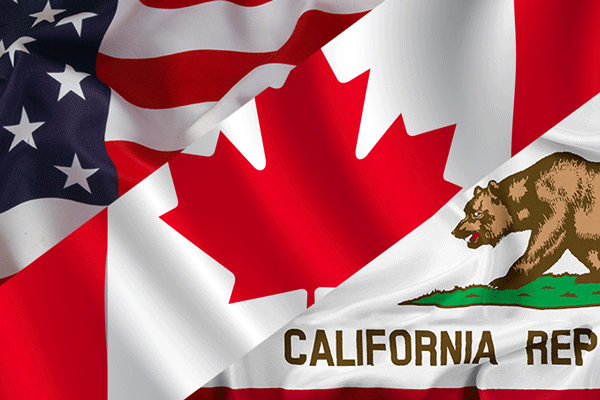
 The power of subnational diplomacy was in evidence recently during the Canada Day at the Capitol Luncheon, presented by the Consulate General of Canada in San Francisco and the California Chamber of Commerce.
Speakers at the March 25 gathering highlighted the many ways in which Californians and Canadians are connected, and attendees showed their appreciation for the shared anecdotes with bursts of laughter and much applause.
The featured speakers were California Food and Agriculture Secretary Karen Ross; David Adkins, executive director and CEO of the Council of State Governments; and Canadian Consul General Rana Sarkar.
Karen Ross
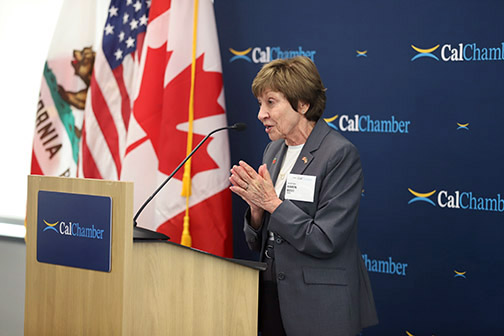
Karen Ross, state secretary of food and agriculture, noted that Canada is the second largest destination for agricultural exports from California, the nation’s No. 1 exporter of agriculture goods. Besides accepting 35% of California wine exports, Canada receives 85% of lettuces and 60% of strawberries grown in California.
More important, Ross said, is the relationship, the friendships — “the ease with which we cross borders, the ease with which we do business together, the importance of the environmental work that we’ve done, and the partnership on so many things around climate and climate-smart agriculture.”
She concluded: “We celebrate the good business ties, the economic ties, but most importantly, we celebrate friendship and the continual investment in creating relationships that work across borders for the good of all.”
David Adkins
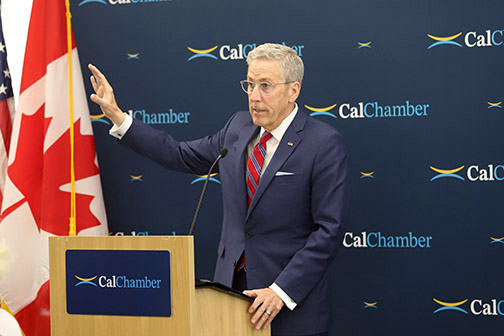
David Adkins, executive director and CEO of the Council of State Governments, emphasized that “subnational relationships — relationships between the Canadian provinces and the American states — are vital, sustained, and something that we can all celebrate.”
At the subnational level, he said, “innovation is occurring, partnerships are being forged, and the acceleration of innovation is resulting in an alignment of supply chains, the growth of markets, and ultimately the ability for state and provincial officials, with support from their federal governments, to expand prosperity, improve the quality of life, enhance the climate, and move us to a future with technologies that will be exponentially disrupting all of those things.”
Adkins listed the many links between Canada and the United States, from shared legal traditions to both countries having the strength that comes from being nations of immigrants. Other shared interests he cited ranged from dual citizens, sports, comedians and actors, to opportunities embodied in the U.S.-Mexico-Canada Agreement (USMCA).
He voiced optimism about future relations given the history of the alliance. Brave Canadians were among the armed forces who lost their lives to take the beaches of Normandy on D-Day in World War II, he reminded listeners.
“We’re more than neighbors, we’re more than friends, we are truly allies, connected inextricably in crafting a future that is not only better for us, but for the entire globe,” Adkins said.
“I know Canada and the United States will find the footing in the future to make the decisions that are in the best interests of both nations, because the character of those nations will always reflect the best qualities of the people of those nations,” he said.
Rana Sarkar
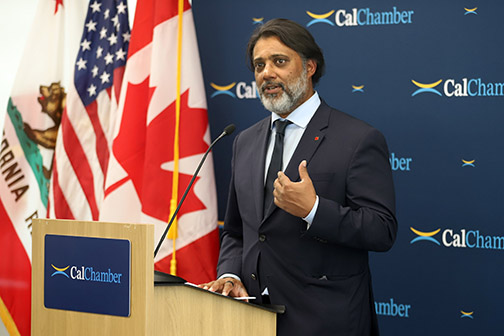
Keynote speaker Rana Sarkar, dean of the consular corps in San Francisco, cited the power of the human connections between Canada, the United States and California.
“At this disruptive moment,” he said, “there’s also an opportunity” for California and Canada “to build a more resilient model of a North American partnership.”
Worth repeating, he said, is that if California were a country, it would be one of Canada’s largest trading partners in the world. “The subnational partnerships in this room,” he told listeners, are “extremely meaningful.”
Canada-California trade “would register as a bilateral relationship by any global standards,” Sarkar said. Numbers to remember, he said, include:
- More than $48 billion of two-way trade and investment flows between Canada and California each year. Canada is California’s seventh largest two-way trade partnership by volume.
- More than 750 Canadian-owned companies operate across the state, employing close to 100,000 Californians in fields ranging from cybersecurity to medical science, real estate, clean energy and financial services.
- Canada buys more of California’s agricultural products than Mexico, China, Japan and South Korea combined.
Between its pension funds, insurance and other sectors, Canada has multitrillion dollars of capital, of which more than $1 trillion is invested in the United States, much of that in California, Sarkar noted.
The Canadian entities have invested deeply into California’s ports, highways, energy systems and technology platforms, he said. “And this is patient, long-term capital that doesn’t seek quarterly returns; it seeks decades-long sustainability.”
That capital depends fundamentally on the “predictability of the rules of engagement,” he said, like what the USMCA provides.
Canadian Prime Minister Mark Carney has described the current moment as a “world of variable geometry — a global economy where integration increasingly depends on trust, alignment, shared values, rather than on sheer scale alone,” Sarkar said.
In this world of variable geometry, Sarkar continued, “the most successful economies will be those that trade with each other equally, and also those who trade most deeply with partners they trust the most…so this is a strategic relationship between Canada and California.”
He pointed out that tariff-driven price increases on Canadian products have increased costs for California and U.S. goods. For example, the tariff on potash, a fertilizer on which the agricultural sector depends, has increased costs for growers in California’s Central Valley and the Central Coast. Canada supplies 73% of U.S. potash imports.
Tariffs on Canadian lumber, he said, have added an estimated $35,000 to $45,000 to the cost of building a single home.
An important element of relations between the nations is Canada’s production of intermediate goods that make up U.S. products that are sold on, Sarkar said. “We build things together,” he noted.
U.S. manufacturing, he said, sources more imports from Canada than any other country.
Oil and gas also is a significant component of the trade between Canada and the United States. “Given the uncertain geoeconomic and geopolitical times…we can be a reliable, low-cost and sustainable supplier in energy,” he said.
In a March visit to the nation’s capital, Sarkar said, he told his interlocutors: “This is the moment to get up and to talk to your American counterparts, your Canadian counterparts, your global counterparts, and to say: ‘We need a stable basis of a global order that starts with a very strong North America.’”
Western countries, including Canada and the United States, are “in the midst of building the architecture that is going to sustain us for potentially the next 100 years,” Sarkar commented. “We are very excited to be building alongside of you,” he told the audience, “and we’re very excited to be building with the CalChamber.”
Staff Contact: Susanne T. Stirling