Trading Partner Portal: Australia

California and the Australian state of Queensland ink new partnership
to accelerate climate resilience, agricultural technology, and innovation
Governor of California, September 3, 2026
Trade Mission secures primary industries innovation agreement with Californian Government
Government of Queensland Australia, September 2, 2026
United States-Australia Framework For Securing of Supply in the Mining and Processing of Critical Minerals and Rare Earths
The White House, October 20, 2025
Fact Sheet: President Donald J. Trump Closes Billion-Dollar Deals with Australia
The White House, October 20, 2025
Trade Overview
Australia has a market economy with a GDP of $1.80 trillion and a population of 27.61 million.
Australia’s diverse landscape and abundant natural resources has provided the country high level of foreign investment for exporting commodities such as coal, iron ore, copper, gold, natural gas, uranium and renewable energy sources.
U.S. – Australia Trade
In addition to being a large exporter of natural resources, energy, and food, Australia also has a significant service sector. Australia has always enjoyed a strong trade relationship and a diverse portfolio with the U.S. In 2025, two-way goods trade equaled $62.82 billion.
Total exports were $33.70 billion with top categories being transportation equipment ($6.17 billion), non-electrical machinery ($5.25 billion), computer and electronic products ($5.24 billion), chemicals ($3.81 billion), and primary metal manufactures ($2.26 billion).
Imports to the U.S. from Australia totaled $29.12 billion in 2025, with primary metals making up the bulk of imports, totaling $14.36 billion. This was followed by processed foods ($6.40 billion), goods returned ($1.79 billion), chemicals ($1.28 billion), and computer and electronic products ($1.18 billon).
Services trade between Australia and the United States totaled $40.73 billion in 2025, with exports totaling $27.37 billion. Top exports included travel, financial, telecommunications, computer, & information services, other business services, and charges for intellectual property use.
Imports of services form Australia to the United States totaled $13.26 billion. Top imported services were other business services, travel, transport services, telecommunications, computer, & information services, and financial services.
Australia – California Trade
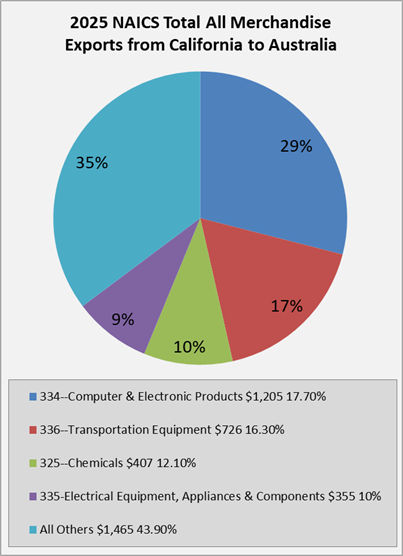
In 2025, California exported approximately $4.16 billion to the country, making it one of the largest exporting states to Australia. The largest export category from California was computers and electronic products making up $1.21 billion of the total. This was followed by transportation equipment ($726 million), chemicals ($407 million), electrical equipment, appliances & components ($355 million), and miscellaneous manufactures ($326 million).
Imports to California from Australia totaled roughly $2.93 billion in 2025, a growth of 22%, and making it the second largest importing state from Australia. Top imports were processed foods ($1.54 billion), primary metal manufactures ($314 million), computer and electronic products ($310 million), reimports ($196 million), and beverages & tobacco products ($91 million).
FDI – Australia
Australia’s total FDI into the U.S. totaled $115.07 billion in 2025, making it the 10th largest source of FDI in the United States. Australian FDI supported 90,100 jobs in the U.S., with $271 million was invested in research and development, and $3.3 billion went to expanding U.S. exports. The top industry sectors that were recipients of Australian FDI were: software and IT services, healthcare, business services, communications, industrial equipment, and financial services. SelectUSA
U.S. FDI into Australia totaled $190.41 billion in 2025. (Bureau of Economic Analysis).
In California, the seventeenth largest source of FDI through foreign-owned enterprises (FOEs) is Australia. In 2025, Australian FOEs in California provided 11,182 jobs through 404 firms amounting to $1.28 billion in wages. The top jobs by sector are manufacturing, wholesale trade, professional/ business services, construction, and financial activities (World Trade Center Los Angeles FDI Report).
Australia and World Trade
Australia is actively involved with Asia-Pacific Economic Cooperation (APEC) as well as engaged in the Trans-Pacific Partnership talks in an effort to lower barriers to trade.
APEC was formed in 1989. It serves as a multilateral forum in which Asian and Pacific economies can solve economic problems and cooperate in developing key economic sectors.
On February 4, 2016, after more than five years of negotiations, trade ministers representing Australia, Brunei Darussalam, Canada, Chile, Japan, Malaysia, Mexico, New Zealand, Peru, Singapore, United States, and Vietnam, signed the Trans-Pacific Partnership Agreement (TPP) in Auckland, New Zealand.
More Articles:
Governor Newsom Announces New Climate Partnership With Australia
Office of Governor Gavin Newsom, August 15, 2023
Interview with AmCham Australia – California Innovation Ecosystem Central to Future Prosperity for Australia, U.S.
CalChamber, August 20, 2021
Interview Series Featuring California’s Key Trading Partners – Featuring Consuls General of Australia Jane Duke in Los Angeles and Nick Nichles in San Francisco:Shared Values Underpin Enduring Mateship Producing Jobs,
Prosperity for Both Partners
CalChamber, November 17, 2020
CalChamber Resources
- American Chamber of Commerce in Australia
- Australian Consul in California
- Australian-American Chamber in California
- International Trade FAQs
- GO-Biz Stats: Australian FDI in CA
Business
- U.S. Commercial Service, Australia
- American Australian Association
- Austrade’s San Francisco Landing Pad for Businesses
- Austrade OnLine Access USA
- Australia Constructors’ Association
- Australian Business Limited
- Australian Chamber of Commerce & Industry
- Business SA
- Chamber of Commerce & Industry of Western Australia