

Trading Partner Portal: Malaysia
Overview
Fact Sheet: President Donald J. Trump Secures Peace and Prosperity in Malaysia
The White House, October 26, 2025
Agreement Between the United States of America and Malaysia on Reciprocal Trade
The White House, October 26, 2025
Memorandum of Understanding Between the Government of the United States of America and the Government of Malaysia Concerning Cooperation to Diversify Global Critical Minerals Supply Chains and Promote Investments
The White House, October 26, 2025
Joint Statement on United States-Malaysia Agreement on Reciprocal Trade
The White House, October 26, 2025
Trade Overview
 Malaysia is located in Southeast Asia with the South China Sea separating the country into peninsular sections, Malaysia and East Malaysia (located on the island of Borneo). Malaysia borders Thailand, Indonesia, and Brunei, with Singapore just off the coast of peninsular Malaysia. Malaysia boasts a population of 35.56 million people with a GDP of $421.97 billion. It is roughly the size of New Mexico and has a tropical climate.
U.S. – Malaysia Trade
Two-way trade between the United States and Malaysia reached $88.52 billion in 2025. The U.S. exported $28.87 billion to Malaysia, with top export categories being computers & electronic products ($13.02 billion), transportation equipment ($3.58 billion), non-electrical machinery ($2.1 billion), chemicals ($1.99 billion), and oil & gas ($1.37 billion). The United States is one of Malaysia’s largest export destinations, while Malaysia stands as the United States’ 20th largest export destination.
The U.S. imported $59.66 billion from Malaysia in 2025, with computer and electronic products making up $35.46 billion of the total. Other top imports included electrical equipment, appliances & components ($5.31 billion), miscellaneous manufactures ($3.15 billion), non-electrical machinery ($2.85 billion), and chemicals ($2.41 billion). U.S. Department of Commerce
California-Malaysia Trade
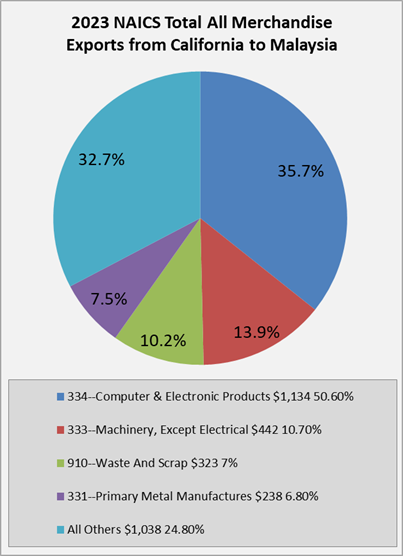
In 2025, California exported $4.89 billion to Malaysia. Trade between Malaysia and California was dominated by computers and electronic products, which made up $2.63 billion, followed by non-electrical machinery ($608 million), electrical equipment, appliances and components ($319 million), waste and scrap ($294 million), and fabricated metals products ($161 million).
Imports from Malaysia to California totaled $12.29 billion in 2025. Top imports were computer and electronic products ($7.71 billion), electrical equipment, appliances & components ($961 million), miscellaneous manufactures ($763 million), processed foods ($453 million), and chemicals ($446 million).
FDI – Malaysia
According to the most recent figures in 2024, the U.S. FDI in Malaysia was nearly $23.92 billion, where Malaysia direct investment position in the U.S. was $1.2 billion. Malaysian FDI supported about 3,200 jobs in the U.S., with Malaysian firms contributing $25 million to expanding U.S. exports. Top industry sectors of Malaysian FDI were business services, plastics, metals, industrial equipment, medical devices, and minerals. (U.S. Department of Commerce, Bureau of Economic Affairs, Select USA)
Trade Agreements
Trade Agreements
Malaysia is a member of a few large multilateral forums, such as APEC (Asia Pacific Economic Cooperation), and it is a founding member of ASEAN (The Association of South East Asian Nations).
Proposed U.S. – Malaysia Free Trade Agreement
In 2005, the United States and Malaysia announced that they would begin negotiations on a bilateral free trade agreement to eliminate trade barriers between the two nations. Negotiations continued throughout 2006 and then were halted after April 2007. Some of the unresolved issues include financial services, intellectual property, competition policies, government procurement and labor.
Both countries had hoped to reach a deal by early 2007. But talks were delayed by a change in Malaysia’s lead negotiator and Kuala Lumpur’s hesitation to open the country’s government procurement market to more U.S. companies.
Regional Comprehensive Economic Partnership (RCEP)
After 8 years of negotiations, the Regional Comprehensive Economic Partnership (RCEP) was signed on November 15, 2020. The RCEP is a free trade agreement (FTA) with 10 Association of Southeast Asian Nations (ASEAN) member states—Brunei, Burma (Myanmar), Cambodia, Indonesia, Laos, Malaysia, the Philippines, Singapore, Thailand, Vietnam—and the five states with which ASEAN has existing FTAs—Australia, China, Japan, South Korea and New Zealand.
Please see the CalChamber’s RCEP page for more info.
RCEP – Association of Southeast Asian Nations
Text of the Regional Comprehensive Economic Partnership Agreement