US Supreme Court Ruling Allows Cities to Restrict Public Camping
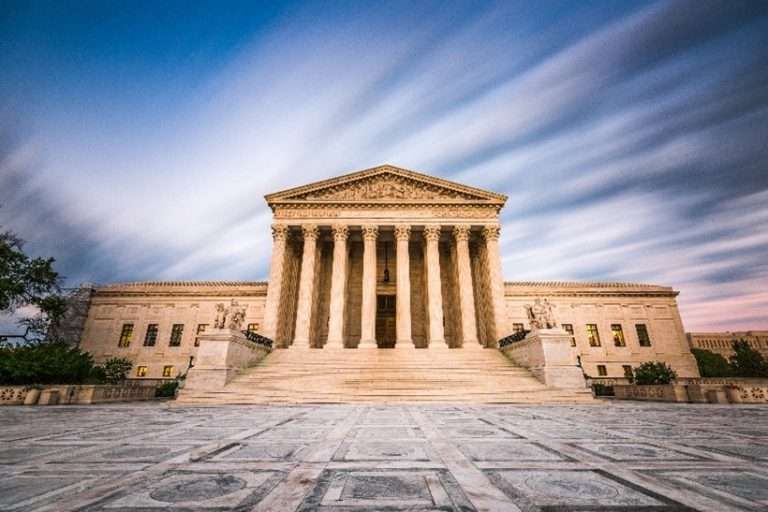
The U.S. Supreme Court on Friday overturned a lower court’s decision which held that enforcing criminal restrictions on public camping violates the cruel and unusual punishment clause of the Eighth Amendment unless the target of enforcement has access to adequate temporary shelter.
The ruling grants cities the authority to enforce laws restricting homeless encampments on sidewalks and other public property.
In a statement, the California Chamber of Commerce said the ruling will give local leaders the ability to more effectively address the needs of the unhoused and of the communities where they reside.
“As we’ve seen in California, homeless encampments are hurting small business as customers are deterred from patronizing stores, employees often feel unsafe entering the workplace, and business owners are left to deal with public health hazards that create additional challenges,” the CalChamber said.
Writing for the majority, Justice Neil Gorsuch wrote, “Homelessness is complex. Its causes are many. So may be the public policy responses required to address it. At bottom, the question this case presents is whether the Eighth Amendment grants federal judges primary responsibility for assessing those causes and devising those responses. It does not.”
He added that Grant Pass’ regulations on camping do not inflict “terror, pain or disgrace,” nor does it criminalize being homeless.
“Under the city’s laws, it makes no difference whether the charged defendant is homeless, a backpacker on vacation passing through town, or a student who abandons his dorm room to camp out in protest on the lawn of a municipal building,” Justice Gorsuch wrote.
Background
The case before for the Supreme Court, City of Grants Pass, Oregon v. Gloria Johnson, et al., challenged the decision in Martin v. City of Boise. The primary questions before the nation’s highest court were whether the enforcement of generally applicable laws regulating camping on public property constituted “cruel and unusual punishment” prohibited by the Eighth Amendment.
The ruling in Martin v. City of Boise resulted in cities throughout the Ninth Circuit finding themselves handcuffed when attempting to ameliorate the homelessness crisis.
In 2023, the Ninth Circuit extended its previous ruling to prevent enforcement of even generally applicable camping ordinances in the case of Johnson v. City of Grants Pass.
Earlier this year, the CalChamber joined the U.S., Arizona and Montana chambers, and Oregon Business and Industry in asking the U.S. Supreme Court to reverse the Ninth Circuit Court of Appeals decision in Martin v. City of Boise that prevented local leaders from addressing the needs of the unhoused and hurt businesses and their communities.
Governor Gavin Newsom also filed a brief asking the U.S. Supreme Court to hear the case.