Proposition 65
CalChamber Backs Legislative, Regulatory, Judicial Efforts to Restore Law’s Original Intent
Proposition 65, the Safe Drinking Water and Toxic Enforcement Act of 1986, is the most far-reaching consumer “right to know” law in the nation. Proposition 65 requires California businesses with 10 or more employees to provide a clear and reasonable warning before knowingly and intentionally exposing individuals to chemicals known to cause cancer and/or reproductive toxicity. And contrary to centuries of Anglo-American law, Proposition 65 dispenses with the “innocent until proven guilty” legal maxim, thereby facilitating a growing bounty hunter environment where businesses must decide whether to defend costly lawsuits or settle.
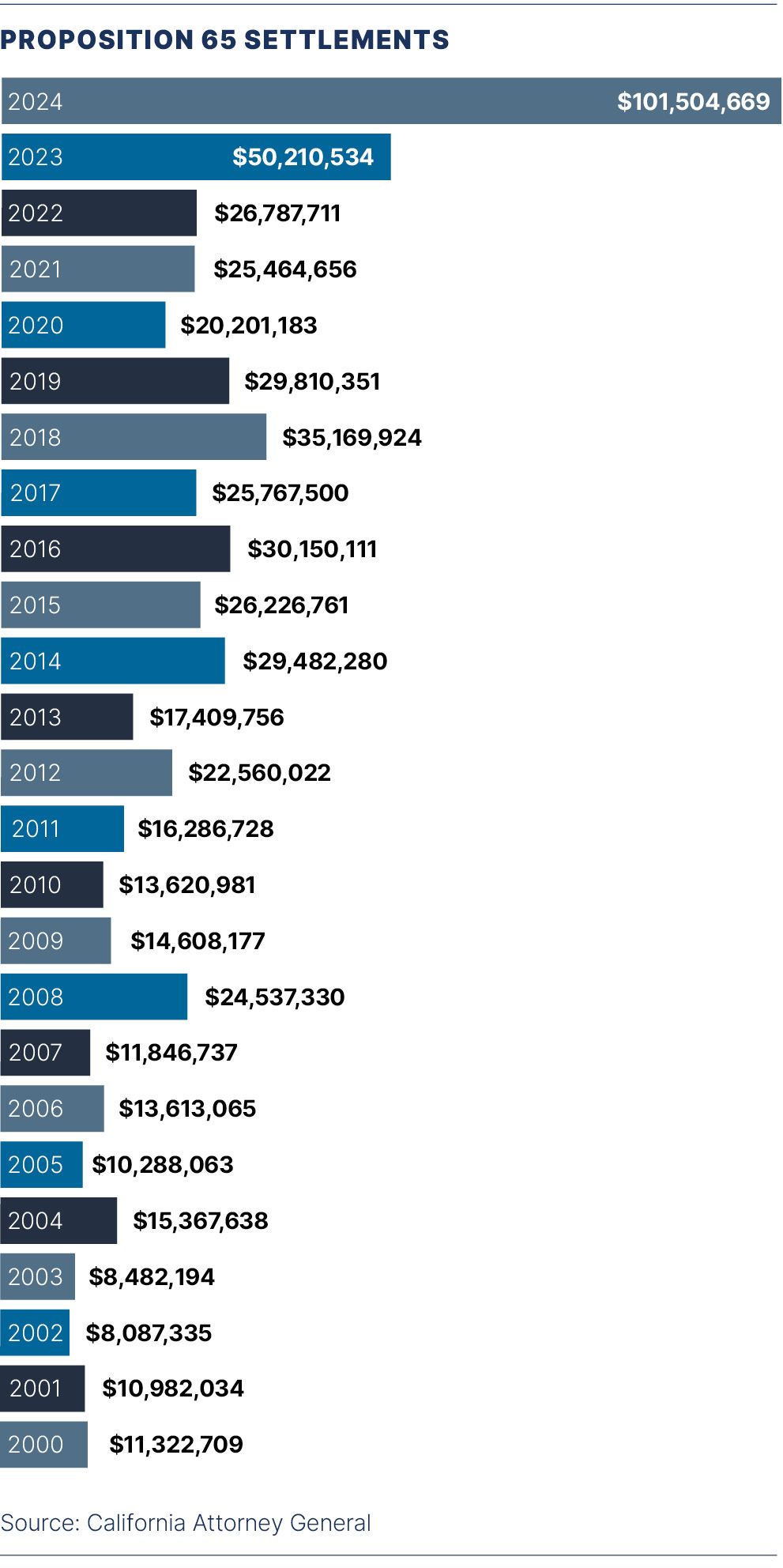
Unfortunately, the simple and supportable goals of Proposition 65 continue to be undermined by some attorneys who use the law for personal financial gain. Proposition 65 contains a private right of action, which allows private persons or organizations to bring actions against alleged violators of Proposition 65 “in the public interest.” This has led to the growth of a multimillion-dollar industry of “citizen enforcers” or “bounty hunters” who often enrich themselves by using the statute’s warning label requirements as an excuse to file 60-day notices and lawsuits to exact settlements under Prop 65’s unique legal regime that leaves a defendant “guilty until proven innocent.” The business community’s concern regarding Proposition 65 litigation abuse is supported by statistical data from the California Attorney General’s Office in its Annual Summary of Proposition 65 Settlements. Every year, tens of millions of dollars are extracted from businesses by bounty hunters looking for easy settlements. In 2022, there were more than 890 Proposition 65 settlements totaling more than $26 million. By 2024, that number exploded to more than 1,300 settlements totaling just more than $101 million.
Multitude of Lawsuits, Warnings
Rampant Proposition 65 “shakedown” lawsuits harm California consumers by driving up costs, creating confusion, and undermining the law’s original intent to protect public health. Businesses facing frivolous or excessive lawsuits must allocate significant resources to legal fees, settlements and compliance costs, which ultimately are passed on to consumers in the form of higher prices. This financial burden disproportionately affects small businesses, which struggle to absorb these costs and often have to limit product availability or raise prices even further.
Additionally, over-warning resulting from Proposition 65 misuse dilutes the effectiveness of the law. The proliferation of warning labels — many on products with negligible or no real risk — creates consumer fatigue and skepticism, reducing the impact of warnings on genuinely hazardous substances. Instead of empowering consumers to make informed decisions, this misuse confuses and misguides them, undermining the trust and credibility of Proposition 65. For the law to serve its intended purpose, reforms are needed to curb frivolous lawsuits and refocus its application on meaningful risks, ensuring genuine consumer protection without unnecessary economic harm.
CalChamber Sues California Attorney General
On behalf of its members, the California Chamber of Commerce filed a lawsuit on October 7, 2019 to stop the multitude of Proposition 65 warnings for the presence of acrylamide in food.
The lawsuit filed against then-Attorney General Xavier Becerra, who is responsible for enforcing Proposition 65, asks the U.S. District Court, Eastern District of California to stop the Attorney General and private enforcers from proceeding with Proposition 65 litigation over acrylamide in food.
CalChamber’s lawsuit seeks to limit this recent trend of shakedown lawsuits with regard to acrylamide that are exploiting Proposition 65 for financial gain, exacerbating over-warnings, and raising costs on food products in California. After CalChamber successfully secured a preliminary injunction by the Federal District Court, the case was appealed to the Ninth Circuit, where CalChamber again prevailed on the merits.
At the time of this article’s drafting, CalChamber is seeking Summary Judgment on the matter. If successful, the precedent established by this case could help pave the way for further changes to Proposition 65.
OEHHA Fundamentally Changes Short-Form Warnings
For years, the Office of Environmental Health Hazard Assessment (OEHHA) has proposed regulatory amendment packages often described by the agency as “merely clarifying existing law,” but which from the perspective of the business community, have often undermined existing protections provided for businesses.
Such was the case when on December 6, 2024, OEHHA fundamentally changed Proposition 65 regulations again under the guise of “clarifying amendments” to Article 6, Clear and Reasonable Warnings Short-Form Warnings. However, these “clarifying amendments” completely upended one of the most widely used and relied upon warning methods, known as “short-form warnings.” The regulatory changes adopted require all short-form warning labels to include at least one chemical name. For many businesses that relied on the prior regulations, that change will upend entire warning regime structures on products.
The CalChamber led a coalition of 119 organizations, representing tens of thousands of companies, opposing the agency’s major changes to Article 6 warning requirements on the basis that the proposed changes were not supported by substantial evidence, injected substantial confusion into the market, failed to consider reasonable alternatives, and imposed substantial financial burdens and additional litigation risks on businesses.
Although the business opposition did not stop the agency from making the changes, the coalition did persuade the agency to provide three years for businesses to make the updates to their warning programs, make explicit that short-form warnings may be used to provide safe harbor warnings for food products, and provide an additional 60-day transition period for retailers to update online short-form warnings after notice from a manufacturer.
California Proposition 65 Legislation
As originally adopted by California voters, Proposition 65 prohibits any amendments by the California Legislature unless such amendments are approved by a two-thirds majority in both the Senate and Assembly. Further, any amendment must “further the purposes” of Proposition 65. These twin limitations have prevented any serious efforts at reform for decades.
Despite the long odds, from time to time a Proposition 65 reform bill will be introduced, as was the case in 2024 when Assemblymember Mike Fong (D-Alhambra) introduced AB 3004. The bill sought to make modest changes to Proposition 65 by requiring additional notice and the factual information underlying the basis of the certificate of merit be provided to an alleged violator. The bill ultimately was held on the suspense file in its house of origin, again illustrating that legislative reform of Proposition 65 is illusory.
CalChamber Position
The CalChamber supports the underlying intent of Proposition 65, which is to ensure that consumers can make reasoned and informed choices when they purchase consumer products or enter certain establishments. Unfortunately, the intent of Proposition 65 has been undermined by ever-increasing attempts to use the law solely for profit, which has exploded into a multimillion-dollar cottage industry. For this reason, CalChamber ardently supports significant reforms to end frivolous, “shakedown” lawsuits, improve how the public is warned about dangerous chemicals, and strengthen the scientific basis for warning levels and initial listings.
Although achieving these goals legislatively has proven nearly impossible, CalChamber remains committed to initiating or supporting efforts to restore the original intent of the law. Whether proposed in the legislative or regulatory forum, or via changes through litigation, CalChamber will continue to lead the business community on this critically important issue to protect businesses from Proposition 65 abuses and to help restore Proposition 65 to its original intent of protecting California consumers.
Proposition 65 Warning Regulations Synopsis
On August 30, 2016, the California Office of Administrative Law approved California’s nearly three-year effort to overhaul Proposition 65’s longstanding warning regulations. The new regulations, promulgated by the Office of Environmental Health Hazard Assessment (OEHHA), are a significant departure from the rules that businesses have relied on for decades. Accordingly, businesses will have to reassess and potentially overhaul their long-established compliance programs.The new regulations provide “safe harbor” warning content and methods for consumer product exposures, environmental exposures, occupational exposures, and tailored “safe harbor” warnings and methods for specific types of products and facilities. The new regulations also clarify the responsibility between manufacturers, retailers and others in the supply chain to provide warnings. Although the regulations were adopted on August 30, 2016, there is a two-year phase-in period. Therefore, businesses need not comply with the new regulations until August 30, 2018, but may choose to comply with the new regulations before that time.
Below is a summary of key provisions of the new regulations. To read the full regulation, visit the OEHHA website http://oehha.ca.gov/media/downloads/crnr/art6regtextclean090116.pdf.
New Consumer Product Warning Content
- “Can Expose”: Consumer product warnings must begin with “This product can expose you to . . .” This is a departure from the current warning regulations, which require safe harbor warnings to begin with “This product contains . . .”
- Chemical Specification: If a warning is not provided on the product itself, such as on a shelf display or a store sign, a business must name at least one chemical for which the warning is being provided and specify whether that chemical is known to cause birth defects or reproductive harm, cancer, or both. If warning for one chemical that is a carcinogen and a separate chemical that is a reproductive toxicant, the warning must specify both chemicals. If warning for one chemical that is both a carcinogen and a reproductive toxicant, such as lead, the warning need only specify that chemical. This is a significant change. With the exception of warnings for alcohol, the prior safe harbor warnings do not require warnings to specify chemicals.
- Pictogram: All safe harbor warnings except for food and dietary supplement exposures must contain a pictogram on the left side of the warning of an exclamation point encompassed by an equilateral triangle. Although the triangle must be printed in yellow, it may be printed in black and white only if the sign, label, or shelf tag for the product is not printed using the color yellow.
- URL: All safe harbor warnings must end with “For more information go to www.P65Warnings.ca.gov.” This URL, which is governed by a separately adopted regulation, provides information in the form of “fact sheets” for certain chemicals and provides links to third-party sources for additional information. Perhaps most significantly, the website regulation allows OEHHA to request a plethora of highly technical information from businesses about their warnings. If in receipt of such request, businesses are not required to perform any new or additional testing or analysis to respond to the request. Further, the website regulation contains protections for confidential business information and information subject to legal privilege.
- Translation Requirements: Safe harbor warnings must be provided in English, and if a product sign, label, or shelf tag used to provide a warning also contains consumer information in a language other than English, the Proposition 65 warning also must be provided in that language. The regulation defines “consumer information” as “warnings, directions for use, ingredient lists, and nutritional information.” Consumer information, however, does not include “the brand name, product name, company name, location of manufacture, or product advertising.”
- Cancer Warning:
WARNING: This product can expose you to chemicals including [name of one or more chemicals], which is [are] known to the State of California to cause cancer. For more information go to www.P65Warnings.ca.gov. - Reproductive Toxicity Warning:
WARNING: This product can expose you to chemicals including [name of one or more chemicals], which is [are] known to the State of California to cause birth defects or other reproductive harm. For more information go to www.P65Warnings.ca.gov. - Cancer and Reproductive Toxicity Warning:
WARNING: This product can expose you to chemicals including [name of one or more chemicals], which is [are] known to the State of California to cause cancer, and [name of one or more chemicals], which is [are] known to the State of California to cause birth defects or other reproductive harm. For more information go to www.P65Warnings.ca.gov. - Chemical that Is Both a Carcinogen and a Reproductive Toxicant Warning
WARNING: This product can expose you to chemicals including [name of one or more chemicals], which is [are] known to the State of California to cause cancer and birth defects or other reproductive harm. For more information go to www.P65Warnings.ca.gov.
New Consumer Product Warning Methods
- Brick-and-Mortar Sales:
Warnings that meet the content requirements above will be deemed “clear and reasonable” so long as they are provided using one or more of the following methods:
1) A product-specific warning provided on a posted sign, shelf tag, or shelf sign for the product at each point of the display;
2) a product-specific warning provided via any electronic device or process that automatically provides the warning to the purchaser prior to or during purchase;
3) a product label; or
4) an on-product (i.e., “truncated” warning) as discussed above. This is also a significant change from the prior regulations, which, consistent with the Act, allow warnings to reach the consumer before exposure, i.e., use of the product. Warnings in operating manuals or inside of a boxed unit (such as slip sheets) would not meet this new requirement. - Internet Sales:
Warnings that meet the content requirements above will be deemed “clear and reasonable” so long as they are provided:
1) on the product display page;
2) a clearly marked hyperlink using the word “WARNING” on the product display page; or
3) by otherwise prominently displaying the warning to the purchaser prior to completing the purchase. - Catalog Sales:
Warnings that meet the content requirements above will be deemed “clear and reasonable” so long as the warning is provided in a manner that clearly associates it with the item being purchased.
Additional Considerations
- Truncated Warnings:
Manufacturers may provide a short-form warning if they provide the warning on the product, such as on the immediate container (box, packaging) or product wrapper. Importantly, such short-form warnings need not specify the chemical for which the warning is being provided. Examples of short-form warnings are as follows:
Cancer: WARNING: Cancer – www.P65warnings.ca.gov
Reproductive Toxicity: WARNING: Reproductive Harm – www.P65warnings.ca.gov
Cancer and Reproductive Toxicity: WARNING: Cancer and Reproductive Harm – www.P65warnings.ca.gov
- Supplemental Information:
If businesses want to provide supplemental information to their warnings, such information must be limited to identifying the source of the exposure or providing information on how to reduce exposure if the business would like to benefit from safe harbor protection. Other supplemental information may be included so long as it is not part of the warning content (i.e., package insert or instruction manual). - Alternative Warnings:
The regulations allow businesses to warn any way they please, but such warnings will not benefit from “safe harbor” protection, and thus businesses providing alternative warnings will have to defend those warnings as being “clear and reasonable” under the Act if challenged. - Court-Approved Warnings:
A business that is warning pursuant to a court-ordered settlement or final judgment entered before August 30, 2018 may continue to warn using the court-approved warning content and methods notwithstanding the new regulations. Businesses should be aware, however, that this “grandfathering” provision only covers the specific product at issue and company providing the warning. Other companies who sell similar products do not have grandfathering protection, but may request OEHHA to adopt the same or similar warning program through regulation. - Unlimited Sell-Through:
Products manufactured before the effective date of August 30, 2018 may comply with the current warning regulations and need not comply with the new warning regulations, even if the product is sold in the stream of commerce after the effective date. Products manufactured on August 30, 2018 or later must comply with the new warning regulations.
Allocation of Responsibility Between Retailers and Manufacturers
- A manufacturer, producer, packager, importer, supplier or distributor of a product may comply with the regulations by either (1) affixing a label to the product bearing a warning , (2) providing written notice directly to the authorized agency for a retailer, or (3) entering into a written agreement with the retailer to allocate legal responsibility among themselves.
- If proceeding under (2), the notice must state that a warning is required, include the name or description of the product or specify identifying information such as the Universal Product Code, include all necessary warning materials, and the retailer must provide written confirmation of receipt of the notice electronically or in writing.
- If proceeding under (2), the retailer is responsible for providing the warning when it has “actual knowledge” of the potential exposure, which is defined as five business days after the retail seller receives notice.
Tailored Warnings
The regulations provide tailored warning content and methods for the following:
1) Food Exposure;
2) Alcoholic Beverage Exposure;
3) Food and Non-Alcoholic Beverage Exposure for Restaurants;
4) Prescription Drug Exposure and Emergency Medical or Dental Care Exposure;
5) Dental Care Exposure;
6) Raw Wood Product Exposure;
7) Furniture Product Exposure;
8) Diesel Engine Exposure (Except Passenger Vehicle Engines);
9) Vehicle Exposure;
10) Recreational Vessel Exposure;
11) Enclosed Parking Facility Exposure;
12) Amusement Park Exposure;
13) Environmental Exposure from Petroleum Products;
14) Environmental Exposure from Service Stations and Vehicle Repair Facilities;
15) Designated Smoking Area Exposure.
BPA Emergency Regulation
The state Office of Environmental Health Hazard Assessment (OEHHA) added bisphenol A (BPA) to the Proposition 65 list as a female reproductive toxicant on May 11, 2015. The BPA listing went into effect on May 11, 2016. The same day, OEHHA adopted an “emergency regulation” to allow temporary use of a standard “safe harbor” point-of-sale warning message for BPA exposures from canned and bottled foods and beverages, which often have a long shelf life of more than two years. This was done to avoid a wave of litigation over BPA exposures in canned foods and beverages, and for suppliers and retailers to provide consistent warnings to consumers through posted signs in retail locations.
The emergency warning regulation, which after OEHHA issued an extension, was in effect until December 31, 2017, provided as follows:
- BPA Safe Harbor Warning Content
“WARNING: Many foods and beverage cans have linings containing bisphenol A (BPA), a chemical known to the State of California to cause harm to the female reproductive system. Jar lids and bottle caps may also contain BPA. You can be exposed to BPA when you consume foods or beverages packaged in these containers. For more information go to: www.P65Warnings.ca.gov/BPA. - BPA Safe Harbor Warning Method
The warning must be provided by the retailer at each point of sale (i.e., where customers pay for foods and beverages, such as the cash register or checkout line). The warning must be no smaller than 5 by 5 inches. For products sold over the internet, the warning must be prominently displayed to the purchaser either on the product display page or otherwise on a webpage prior to completing the purchase. - Allocation of Responsibility
Similar to the general Proposition 65 warning regulations, the manufacturer, producer, packager, importer or distributor of the canned and bottled food or beverage may either:
1) affix a label to the product bearing a warning; or
2) provide written notice directly to the retailer seller or an authorized agent stating that the product may cause exposure to BPA and providing a product description and warning materials for the retail seller to use to satisfy the safe harbor requirement.